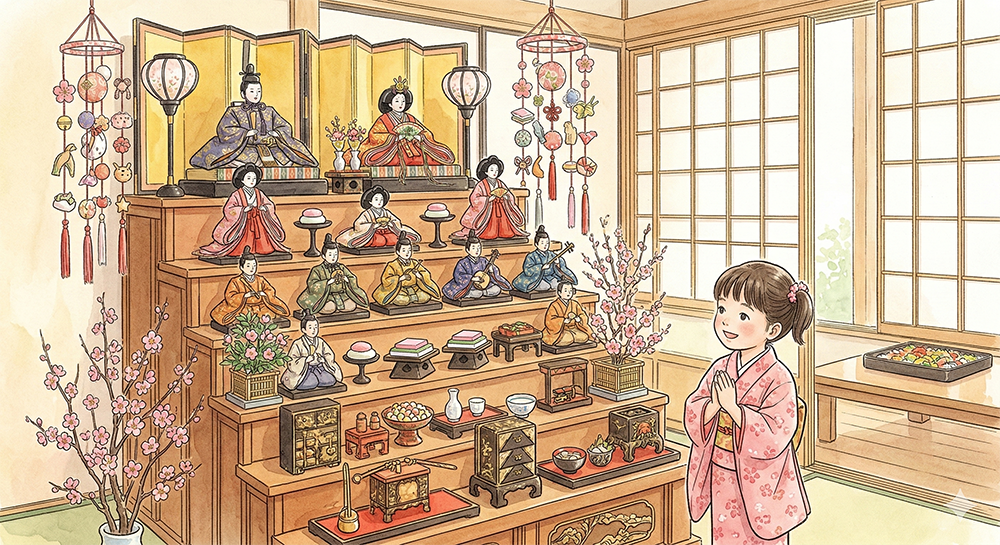
On March 3rd, gorgeous tiered dolls will be displayed in homes, shopping streets, and tourist facilities across Japan.
This is a traditional event called "Hina-matsuri" that prays for the healthy growth of girls. The Peach Festival is one of the five festivals that celebrate seasonal milestones.It is part of Japanese doll culture that has continued since the Heian period. Why decorate dolls? Why March 3rd?
🎎 A game played by Heian aristocrats that brings misfortune to dolls
The origins of the Doll's Festival lie in the ``Hiina Asobi'' (playing with dolls) that was practiced by the children of aristocrats during the Heian period.
This was combined with the ``Kamimi no Sekku'' (the custom of exorcising impurities at waterside on March 3rd) that was introduced from China, and the custom of ``Nagashi Hina'', in which evil spirits and impurities were transferred to dolls made of paper or grass and floated down the river, was born. In the Edo period, the culture changed to displaying instead of floating, and the luxurious tiered decorations that we see today developed.
Points of experience
Doll's Festival is an event where you can enjoy not only watching, but also eating and listening to the festival.
- Meaning of tiered decoration:On the top tier are the ``Odairi-sama'' and ``Hina-sama'' representing the Emperor and Empress, and below them are the three court ladies, the five musicians, the minister of the right, the minister of the left, and the priest. The seven-tiered decoration is a reproduction of the imperial court of the Heian period.
- Traditional food:There is a custom of eating chirashi sushi, clam soup, hina arare, hishimochi, baijiu, etc. Clams are considered to be a symbol of good luck because only opposite shells match.
- Large-scale exhibition:In Takayama City, Gifu Prefecture, Katsuura City, Chiba Prefecture, and Konosu City, Saitama Prefecture, ``Hina Matsuri Events'' are held where thousands of Hina dolls are displayed, and the entire town is brightly colored.
🌸 Hinamatsuri culture in various places
In Kyoto, elegant hina dolls that reproduce costumes from the Heian period are mainstream. On the other hand, in Edo (Tokyo), gorgeous and large tiered decorations were preferred. The features and decorations differ depending on the region, and it is fun to compare the differences.
There is a legend that if you continue to display Hina dolls after March 3rd, your marriage will be delayed, and many families put them away on March 4th.
Why not experience the Japanese spring tradition of peach blossoms and hina dolls?