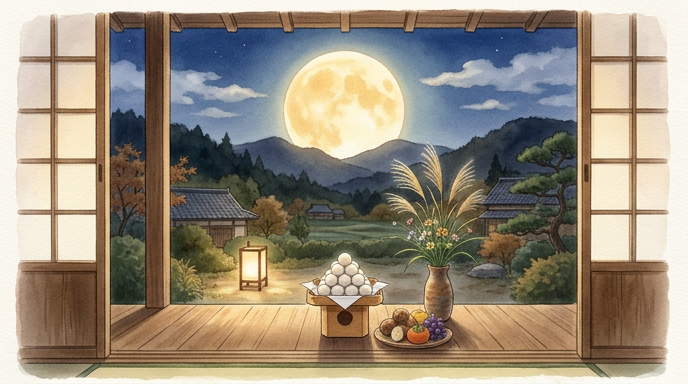
From late September to early October, there are nights when a particularly bright and large full moon rises in the Japanese night sky. The 15th day of the 8th month in the lunar calendar is a night called ``Juugoya'' or ``Chushuu no Meigetsu.''
Jugoya in 2026 will fall on Friday, September 25th. On this night, Japanese people decorate their verandas and windowsills with pampas grass, stack round moon-viewing dumplings, and quietly gaze at the moon with their families. This event, called ``Tsukimi'' (moon viewing), is a typical autumn custom in Japan, expressing gratitude for the harvest and appreciating the beauty of nature.
🌕 From the Chinese Mid-Autumn Festival to the feast of the Heian nobility
The origin of moon viewing lies in the Mid-Autumn Festival, which began during the Tang Dynasty in China. The 15th day of the 8th month on the lunar calendar is positioned as the "middle of the three autumn seasons," and is an event where families gather together to eat mooncakes and admire the moon. Today, it is still an important holiday in Greater China, along with the Spring Festival (Lunar New Year), and Chuseok in South Korea and Tet Trung Tu in Vietnam have the same origins.
The Mid-Autumn Festival is said to have been introduced to Japan in the early Heian period. The oldest recorded moon viewing event is the Moon Viewing Banquet held by Emperor Uda in 909. After that, a culture of admiring the moon on the fifteenth night of August became established among the Heian aristocrats. Floating a boat on a large pond, enjoying the reflection of the moon on the water surface and the moon in the sky at the same time, reciting Japanese poems, playing the orchestra, and exchanging sake cups - this was the image of moon viewing in the Heian period. Osawa Pond at Daikakuji Temple in Kyoto and Sarusawa Pond in Nara have been known as famous moon viewing spots since then.
Moon viewing became popular among the common people during the Edo period. Around this time, unlike the elegant moon viewing of the aristocrats, it was strongly associated with its character as a harvest festival. At this time, before the rice harvest, it was an event to offer autumn fruits such as taro, beans, and chestnuts to the moon to express gratitude for the bountiful harvest. The other name, ``Imomeigetsu,'' comes from the fact that taro was offered as an offering.
Three moons related to moon viewing
Moon viewing in Japan is actually not just about Jugoya. The ancient ideal was to see all three nights.
| name | lunar calendar | 2026 | alias |
|---|---|---|---|
| Jugoya | August 15th | Friday, September 25th | Mid-Autumn Harvest Moon/Imo Harvest Moon |
| 13th night | September 13th | Friday, October 23rd | Later moon, chestnut moon, bean moon |
| ten days and nights | October 10th | Thursday, November 19th | 10 days of cutting |
🎑 Japanese pampas grass, Tsukimi dango, and taro -- the meaning of the offerings
Each moon viewing offering has its own meaning. Although they appear to be arranged casually, each one has been chosen with meaning within Japan's agricultural culture and faith.
Japanese pampas grassare offered to resemble ears of rice. Originally, it was intended to offer ears of rice, but since the rice had not yet been harvested during the Jugoya period and the ears were not yet ready, pampas grass, which had a similar appearance, was used as a substitute. It is also said that the sharp cut edges of pampas grass have the power to ward off evil spirits, and there is still a custom of hanging them under the eaves after viewing the moon to pray for the success of the next year's rice cultivation.
Tsukimi dangois a white round dumpling shaped like a full moon. Dumplings are made by kneading and steaming rice flour, and there are sweet dango seasoned with sugar and simple dango with just a salty flavor. The official way of offering is to pile up 15 pieces on the 15th night and 13 pieces on the 13th night in a pyramid shape on three sides (sanpo = wooden stand). The shapes are different in the Kanto and Kansai regions, with the Kanto region having a perfectly round shape, and the Kansai region having an elongated red bean paste wrapped around a taro.
tarois the offering that gave rise to the name ``Imo Meigetsu'' on Jugoya. Taro, which is harvested during this period, is a root vegetable that has been eaten as a staple food by Japanese people since ancient times, and before Tsukimi Dango became popular, taro itself was the main offering to the moon. Even today, in some areas of Tohoku and Kansai, there are families who always offer boiled taro to the moon. On the thirteenth night insteadChestnuts and edamameThis is why it is also called ``Chestnut moon'' and ``Mamegetsu.''
How to arrange offerings
| offering | meaning | Number/placement |
|---|---|---|
| Japanese pampas grass | In place of ears of rice/talisman | Place 5 to 7 flowers in a vase and place them in a position where the moon can be seen. |
| Tsukimi dango | Offerings made to look like the full moon | Jugoya stacks 15 pieces in a pyramid shape. |
| taro | Symbol of gratitude for the harvest (potato moon) | boiled or with skin on |
| seasonal fruits | gratitude for the harvest | Round things such as pears, persimmons, and grapes are preferred. |
🌾 The culture of gazing at the moon
The act of gazing at the moon has been practiced all over the world, but there are few cultures that have classified and named the moon as precisely as Japan has. The moons before and after the full moon also have names for their appearance, such as "Thirteenth Night," "Fourteenth Night," "Komochizuki," "Tachimachizuki," "Imachizuki," and "Nemachizuki." The moon that stands and waits for the moon to rise, the moon that sits and waits, the moon that lies and waits for the moon to rise - the fact that the Japanese people used such soft words to express how the moon rises later each day after the full moon is an expression of the sensitive sensitivity of the Japanese towards the moon.
The moon appears as a special presence in Japanese classical literature, just as Princess Kaguya returns to the moon on a full moon night in ``The Tale of the Bamboo Cutter.'' Many haiku poets, including Matsuo Basho, Yosa Buson, and Kobayashi Issa, continued to write about the moon. The phrase, ``I walked around the pond all night on a full moon night'' (Basho) shows that admiring the moon was not just a matter of admiring it, but an act of immersing oneself in the moon.
How to enjoy moon viewing
- Enjoy at home:Tsukimi dango and pampas grass will be on sale at supermarkets from mid-September. Miscanthus grass is also available at flower shops. You can recreate the moon viewing experience at home in Japan by simply placing a small stand by the window or balcony and offering dango, pampas grass, and seasonal fruits.
- Moon viewing evening at Daikakuji Temple in Kyoto:At Daikaku-ji's Osawa Pond, which was the stage for moon viewing for the Heian aristocrats, for three days around the 15th night, a boat with a dragon's head and head is floated on the pond, and there is an event where you can enjoy the moon along with gagaku performances. This is a place where you can recreate the moon viewing almost exactly as it was 1000 years ago.
- Nara Sarusawa Pond Ume Festival:The next day, September 25th, the Uneme Festival will be held at Sarusawa Pond in Nara. It is a festival directly connected to Jugoya, in which Kangenbune floats on a pond and people wearing Heian period costumes throw flower fans into the pond. Details will be introduced in the next article.
- Famous moon viewing spots:Places where the moon is reflected on the water have long been considered famous spots for moon viewing, such as Tokyo's Mukaijima Hyakkaen Garden, Himeji Castle, Matsumoto Castle, and Miyagi's Matsushima. Moon viewing events are held in many of these areas in late September.
- McDonald's Tsukimi Burger:An unexpected way to enjoy it is the ``Tsukimi Burger,'' which McDonald's in Japan has released every September since 1991. It is a seasonal product with a round fried egg shaped like the moon, and has now become an established autumn tradition. This is a humorous example of how Japanese food culture has incorporated moon viewing into modern times.
🌙 Harvest moon, not necessarily a full moon
Finally, one fact that is surprisingly unknown. The Harvest Moon does not necessarily mean the full moon. The 15th day of the 8th month in the lunar calendar is just a date on the calendar, and it is often 1 to 2 days off from the actual full moon day. The moon age on September 25th, 2026 is approximately 13.5, and the actual full moon will be on Saturday, September 26th. This error occurs because the moon's orbital period (approximately 29.5 days) does not exactly match the moon in the lunar calendar.
The Heian aristocrats were of course aware of this error, but they still celebrated the 15th day of the 8th month in the lunar calendar as ``Meigetsu'' Day. The essence of Japanese moon viewing lies in valuing the 15th night of mid-autumn as a turning point in the calendar more than the astronomical full moon itself. Even if it's not a completely full moon, or even if it's a little waning, look at the moon that night, sit around the table with your family, and be thankful for the fruits of the season. The time spent looking up at the moon itself may be the essence of this event.
If you're in Japan on the night of September 25th, open your hotel window and look up at the sky. In urban areas, the moon may become hazy due to the city lights, but the presence of the Harvest Moon is still overwhelming. Japanese families still have the custom of turning down the TV volume a little on this night to let the moonlight into the room.