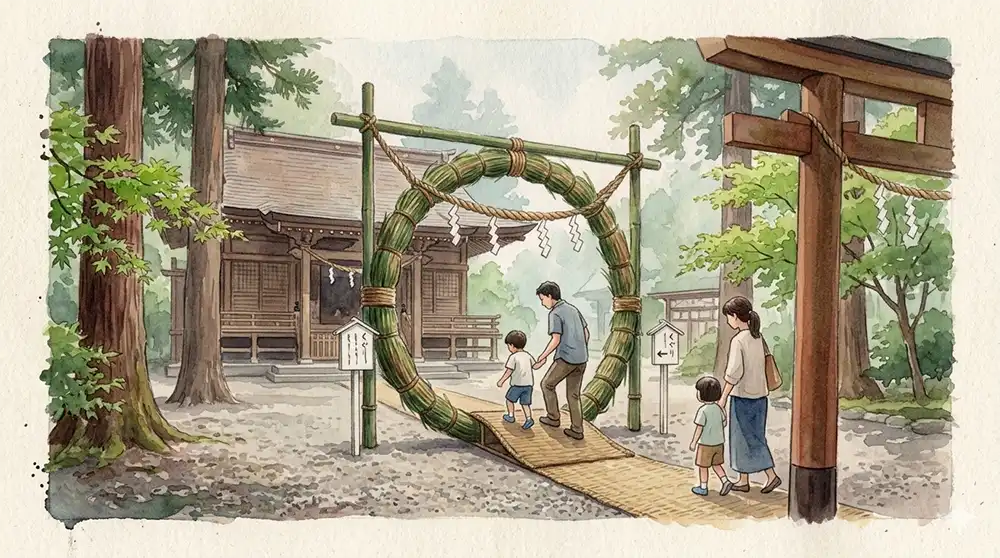
On June 30th, large grass rings are set up in the precincts of shrines across Japan. This ring, called a ``Chinowa'', is made from bundles of Chigaya (a plant belonging to the grass family) and is about 2 to 3 meters in diameter. By passing through this ring according to a set procedure, worshipers purify themselves of the ``Kegare'' that has accumulated over the past six months. This event is called ``Nagoshi no Harae''.
⭕ 茅の輪くぐりの作法
There is a set procedure for passing through the grass ring. First, stand in front of the circle and bow once. Next, step through the ring with your left foot, turn to the left, and return to the front. The second time, step through the ring with your right foot, turn to the right, and return to the front. The third time, pass through the ring with your left foot again, turn to the left, return to the front, and continue through the ring to the shrine.
Many Japanese people remember this method of passing through as "left, right, left," but the procedure may differ depending on the shrine. There is usually a guide board in front of the ring, so even first-timers won't get lost.
The origin of this event is said to be the story of Somin Shourai, recorded in the Bingo no Kuni Fudoki. This is the story of Somin Shora, who entertained a god (Susano-onomikoto) during his travels, and as a thank you, was told that if he wore a grass ring around his waist, he would be protected from the plague.
Points of summer purification
- season:The original day is June 30th, but some shrines set up grass rings from mid-June. If you visit a shrine in late June, you can see grass grass rings in many places.
- Doll (Hitogata):They write their names and ages on paper dolls cut out in the shape of people, stroke their bodies, and then place them in the shrine. The idea is to transfer impurity to the doll. Many shrines distribute them for free or for a small fee (around 100 yen to 300 yen).
- Conducted at shrines nationwide:Summer Purification is not a festival of a specific shrine, but an event held at shrines all over the country from Hokkaido to Okinawa. Meiji Shrine, Kanda Myojin, and Tokyo Daijingu Shrine in Tokyo, Sumiyoshi Taisha Shrine and Osaka Tenmangu Shrine in Osaka, Dazaifu Tenmangu Shrine in Fukuoka, and Itsukushima Shrine in Hiroshima are well-known, but there are also many small local shrines that have grass grass rings installed.
- Minazuki:In Kyoto, there is a custom of eating a Japanese sweet called "Minazuki" on June 30th. As mentioned in article ⑧ (Kasho no Hi), it is a confectionery made of red beans placed on a triangular white ice cream, and its shape that resembles ice has the meaning of warding off the heat.
🔄 一年を半分に分ける「大祓」の思想
Summer Purification is one of the ``Ooharae'' in Japanese Shintoism. Great purification is held twice a year: the Summer Purification on June 30th and the New Year's Purification on December 31st. The idea is to reset the impurity every six months.
"Purity" is not only a moral sin, but also something that naturally accumulates in daily life. Illness, misfortune, and mental and physical fatigue are considered to be a type of impurity, and it is believed that by periodically purifying these impurities, the mind and body can be returned to a pure state.
June 30th marks the halfway point of the year. If you happen to come across a cogon grass ring at a nearby shrine while traveling, follow the instructions on how to pass through the ring. Just by standing in the same line as the Japanese and following the same steps, you can experience the method of dividing seasons that has been used for over 1,000 years. No special reservations or fees are required.