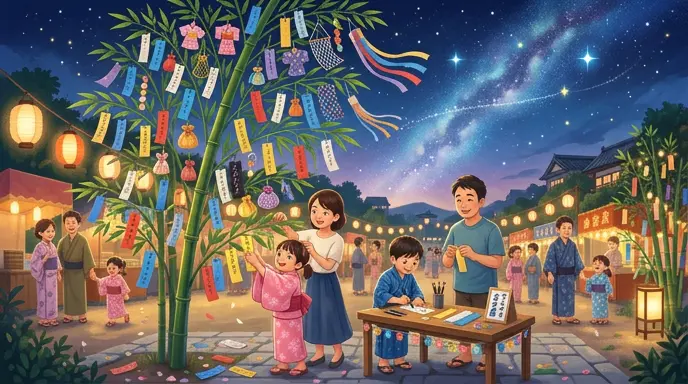
On July 7th, bamboo bamboos are erected in Japanese homes and commercial facilities, and colorful strips of paper (Tanzaku) are hung from them. Tanabata is an event that originates from the Chinese legend ``Kikkouden,'' in which Orihime (Vega in the constellation Lyra) and Hikoboshi (Altair in the constellation Aquila) are allowed to cross the Milky Way and meet once a year. It was introduced to Japan in the Nara period (8th century) and became established as an event in the imperial court.
🎋 Meaning of Tanabata decorations
The centerpiece of Tanabata decorations is a strip of paper. Wishes are written on paper in five colors (blue, red, yellow, white, and black; purple is often used instead) and tied to bamboo. The five colors correspond to the Chinese philosophy of the five elements (wood, fire, earth, metal, water).
In addition to strips of paper, various other decorations are hung on the bamboo bamboo. The ``Kamiko'', which is shaped like a kimono made of paper, symbolizes improvement in sewing skills, the ``Kinchaku'' symbolizes good fortune, the ``Amikazari'' symbolizes a bountiful catch, and the ``Fukinagashi'' symbolizes Orihime's weaving thread. In Japan's kindergartens and elementary schools, classes are held in July where children make their own Tanabata decorations.
Tanabata is one of the ``Sekku'' festivals. Japan has five festivals a year, and Tanabata falls on July 7th. Together with Jinjitsu on January 7th, Joshi (Doll's Festival) on March 3rd, Tango (Children's Day) on May 5th, and Choyo (September 9th), they are called the ``Gosekku''.
Tanabata experience points
- Experience writing strips of paper:In early July, bamboo bamboos are set up in commercial facilities and station premises, and anyone can write their wishes on strips of paper and hang them up. In most cases, strips of paper and brush pens are provided free of charge.
- Tanabata food:There are some regions where ``somen'' is eaten on Tanabata. It is a custom of making thin noodles look like the Milky Way or Orihime threads, and is said to have continued since the Heian period.
- Tanabata in the lunar calendar:July 7th of the new calendar falls during the rainy season in many areas of Japan, and the starry sky is often not visible. There are also Tanabata festivals held in August, which is closer to the lunar calendar, such as the Sendai Tanabata Festival (August 6th to 8th).
🎆 Shonan Hiratsuka Tanabata Festival (July 3rd to 5th)
The "Shounan Hiratsuka Tanabata Matsuri" held in Hiratsuka City, Kanagawa Prefecture is considered one of the three major Tanabata festivals in Japan. In 2026, it will be held for three days from July 3rd (Friday) to July 5th (Sunday).
Large Tanabata decorations fill the shopping arcade, centered around Shonan Star Mall, which extends from the north exit of JR Hiratsuka Station. The maximum size of the decorations can exceed 10 meters, and companies and shopping centers create elaborate decorations every year.
Hiratsuka's Tanabata Festival began in 1951 as a symbol of postwar recovery. While modeled after the Sendai Tanabata Festival, it has developed in its own way. The decorations in the shopping street are hung from above the street, so you can experience walking under them. Approximately 300 food stalls will be set up during the event, and approximately 1.5 million people will visit over the three days. It is about a 5-minute walk from JR Hiratsuka Station to the venue, and about 60 minutes from Tokyo Station on the JR Tokaido Line.