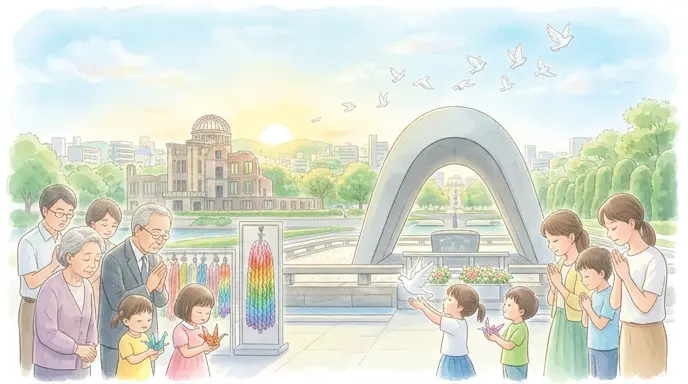
At 8:15 a.m. on August 6, 1945, the American B-29 bomber Enola Gay dropped the atomic bomb "Little Boy" over Hiroshima. The ground temperature near the hypocenter reached 3,000 to 4,000 degrees Celsius, and it is estimated that approximately 140,000 people were killed by the end of that year due to the blast wave, heat rays, and radiation. August 6, 2026 is the 81st summer since that day.
🕊️ 平和記念式典(広島市原爆死没者慰霊式並びに平和祈念式)
Every year on the morning of August 6th, the Hiroshima City Atomic Bomb Victims Memorial Ceremony and Peace Memorial Ceremony (commonly known as the Peace Memorial Ceremony) is held at the Hiroshima Peace Memorial Park in Naka Ward, Hiroshima City. The ceremony begins at 8 a.m., and at 8:15 a.m., all attendees will observe a minute's silence (Mokutou). 8:15 is the time the atomic bomb was dropped.
At the ceremony, the Mayor of Hiroshima will read the ``Peace Declaration'' and children's representatives will make a ``Pledge for Peace.'' On this day, the ``Atomic Bomb Victims List'' containing the names of the atomic bomb survivors who died on this day will be dedicated in the stone chamber of the Atomic Bomb Cenotaph (official name: Hiroshima City of Peace Monument). As of 2024, the number of deaths recorded in the register exceeds approximately 330,000.
The ceremony will be attended by the Prime Minister, the ambassadors of each country to Japan, and the atomic bomb survivors and their bereaved families. The general public is welcome to attend, and advance registration is not required. The venue, Peace Memorial Park, will be open from early morning.
Visiting points in Hiroshima
- Atomic Bomb Dome:This is the remains of the Hiroshima Prefectural Industrial Promotion Center, which was located approximately 160 meters from the hypocenter. It was registered as a UNESCO World Heritage Site in 1996. Although you cannot go inside the building, you can walk around the outside and take a tour.
- Hiroshima Peace Memorial Museum:Materials, belongings, photographs, and video testimonies of atomic bomb survivors are on display that convey the reality of the atomic bombing. It was renewed in 2019 and the exhibition contents have been completely renewed. Admission fee is 200 yen for adults. There is an English audio guide. August 6th will be crowded, so please consider visiting the day before or the next day.
- Atomic bomb child statue:This statue was erected in memory of Sadako Sasaki, who was exposed to the atomic bomb at the age of 2 and died of leukemia 10 years later. The story of the orizuru paper cranes that Sadako kept folding while on her hospital bed is known around the world, and the statue is surrounded by 1,000 paper cranes sent from all over the world.
- Toro Nagashi:On the night of August 6th, an event will be held to float lanterns down the Motoyasu River in front of the Atomic Bomb Dome. Messages of remembrance for the victims are written on the lanterns, and thousands of lights float on the surface of the river. The general public is welcome to participate, and lanterns can be purchased for a few hundred yen each.
- access:Approximately 15 minutes from JR Hiroshima Station by Hiroshima Electric Railway (streetcar) to the Atomic Bomb Dome-mae tram stop. It takes about 3 hours and 50 minutes from Tokyo to Hiroshima by Shinkansen "Nozomi" and about 1 hour and 25 minutes by plane.
📖 被爆者の高齢化と「記憶の継承」
As of 2026, the average age of atomic bomb survivors is over 85 years old. The number of A-bomb survivors who can speak directly about their experiences is decreasing year by year, and Hiroshima City is conducting a project to train ``A-bomb survivors.'' The role of the narrator is to hear directly from the hibakusha and pass on their testimonies on their behalf.
At the Hiroshima Peace Memorial Museum, programs are held regularly to hear testimonies from A-bomb survivors themselves or their successors. Testimony sessions may also be held in English. If your schedule allows, consider adding the experience of not only seeing the exhibits but also hearing the testimonies firsthand to your plans.
August 6th is a day of remembrance in Hiroshima. It is a day that many people visit not as a tourist destination, but as a place to learn about what happened 81 years ago. The Peace Memorial Park and Museum are open year-round, but visiting on this day carries a weight unlike any other.