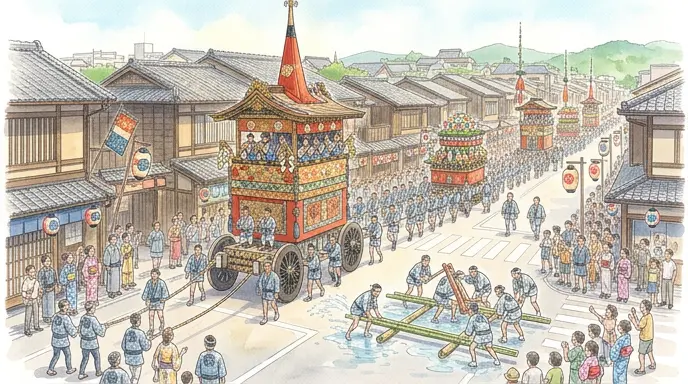
Gion Matsuri in Kyoto is a month-long festival held at Yasaka Jinja Shrine from July 1st to July 31st. It is said to have originated in 869, when an epidemic broke out in the capital, and 66 hoko (hoko) were erected in Shinsenen to hold a gathering for the spirits of the spirits. It has a history of over 1100 years and is counted as one of Japan's three major festivals. It was registered as a UNESCO Intangible Cultural Heritage in 2009.
⛩️ 1か月の祭礼構成
Gion Festival is not a single event, but a collective term for multiple Shinto rituals and events over the course of a month. The main attractions for tourists are:
Pre-festival (Sakimatsuri)
Yoiyama (Yoiyama), from July 14th to 16th, is a three-day event in which floats are displayed in each town. Lanterns are lit and Gionbayashi is played. On the nights of the 15th and 16th, Shijo-dori and Karasuma-dori streets become a pedestrian paradise and stalls are lined up.
On July 17th, 23 floats will depart from Shijo Karasuma and travel from Shijo-dori to Kawaramachi-dori to Oike-dori. The cruise begins at 9 a.m. and continues until after noon.
After Festival (Atomatsuri)
There will be a Yoiyama festival from July 21st to 23rd, and a festival float parade (11 floats) on July 24th. The after-matsuri festival is smaller in scale than the pre-matsuri festival, but there are no stalls and you can enjoy the festival in a calm atmosphere. ``Ofunehoko'', which was revived in 2014 for the first time in about 50 years, and ``Takayama'', which returned to the parade in 2022 for the first time in about 200 years, will be of interest during the after-festival.
Shinko Festival / Kanko Festival
On the evening of July 17th, the three portable shrines from Yasaka Shrine will be carried to Otabisho in Shijo Teramachi during the Shinkosai Festival, and will return to the shrine on July 24th during the Kankosai Festival. The yamahoko parade has the role of ``dew-harvest'' to cleanse the path for the mikoshi togyo.
Viewing points
- Paid seats:Paid viewing seats will be available along Oike Street for both the pre-festival and post-festival. All seats are reserved and will be sold in advance on the Kyoto City Tourism Association website. Sales usually start in early June every year.
- Tsujimawashi:The biggest highlight of the parade is the ``Tsujimawashi,'' which involves changing the direction of the floats 90 degrees at intersections. Place green bamboo under the wheels and sprinkle water on them to make them slide. You can see it in two places: Shijo Kawaramachi and Kawaramachi Oike.
- Yamahoko accessories:The float is decorated with Persian rugs, Gobelins, and dyed textiles from China and India, and is called a ``moving museum.'' During the Yoiyama period, you can climb some of the floats and see the floats up close.
- Chimaki:The ``粽'' sold in each Yamahoko town are not food, but charms made from bamboo leaves to ward off evil spirits. Hang it at your front door to pray for good health throughout the year. The popular Hoko-no-Gama sells out quickly.
- Crowds and heat:Over 300,000 people visit the pre-festival, Yoiyama (especially on the nights of July 15th and 16th). In July, the temperature in Kyoto is around 35℃ and the humidity is high. Hats, parasols, and drinking water are essential items for viewing the parade during the day.
🏮 「祇園祭」が日本全国に広がった理由
Festivals with the name Gion Festival are not limited to Kyoto. As I will discuss in detail in a later article (⑨), there are festivals all over Japan that bear the name "Gion Festival." This is because the belief in Gozu Tennou, the deity enshrined at Yasaka Shrine, has spread throughout the country, and shrines in various regions have started holding their own Gion Festivals. Kyoto's Gion Festival is its ``main family.''
The Gion Festival is a festival that symbolizes Kyoto in July, and can also be said to be the prototype of Japanese festival culture. If you visit Kyoto at any time during the month, you will be able to experience some kind of Gion Festival event. The pre-matsuri festivals, Yoiyama and Junko, are the most crowded, but if you want to enjoy the festival in peace, we recommend the post-matsuri.