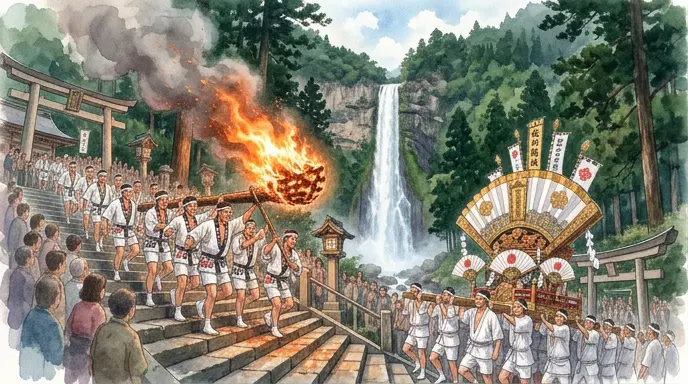
Every year on July 14th, the Nachi no Ougi Matsuri is held at Kumano Nachi Taisha in Nachikatsuura-chou, Wakayama Prefecture. This festival, commonly known as ``Nachi no Himatsuri'', is designated as a national important intangible folk cultural property and is counted as one of Japan's three major fire festivals.
🔥 12本の大松明と12体の扇神輿
The centerpieces of the Nachi Fire Festival are 12 large torches (Ootaimatsu) and 12 portable fans (Ougi Mikoshi). The large torch is about 4 meters long and weighs about 50 kilograms, and is carried by shrine parishioners dressed in white. The Ougi Mikoshi is a fan-shaped mikoshi approximately 6 meters high and 1 meter wide, and is said to symbolize Nachi Falls.
The climax of the festival is when a large torch descends from the top of the stone steps and a portable fan mikoshi rises from below. The parishioners greet the Ougi Mikoshi while holding up blazing torches and chanting "Hariya, Hariya." The sight of torches and portable shrines intertwined in the flames and smoke creates a spectacular scenery with Nachi Falls in the background.
The meaning of this festival is that the gods of Kumano return to Nachi Falls once a year. The fan mikoshi symbolizes a waterfall and is designed to purify the path with the flame of a torch and welcome the gods. The 12 fan mikoshi correspond to Kumano Junisho Gongen.
Viewing points
- Date and time:Tuesday, July 14, 2026. The ritual begins at noon, and the meeting of the large torch and fan mikoshi is around 2:00 p.m. The core part of the festival lasts about an hour.
- Viewing location:The closest viewing location is around Hirou Jinja in front of Nachi Falls, but it is crowded so you will need to arrive early. You can also see it from the middle of the stone steps.
- Nachi Falls:With a drop of 133 meters, it is the highest direct waterfall in Japan. It is one of the constituent assets of the World Heritage Site "Sacred Sites and Pilgrimage Routes in the Kii Mountain Range," and the waterfall itself is worshiped as a sacred object.
- Kumano Kodo:Nachi Taisha is one of the three Kumano shrines (Kumano Hongu Taisha, Kumano Hayatama Taisha, Kumano Nachi Taisha) and one of the final destinations of the Kumano Kodo. Daimon-zaka is a stone-paved pilgrimage path where you can experience walking on an ancient path that takes about 30 minutes on foot to Nachi Taisha Shrine.
- access:Approximately 30 minutes by bus from Kii-Katsuura Station on the JR Kisei Main Line. From Osaka, take the JR Limited Express Kuroshio to Kii-Katsuura Station, approximately 3 hours and 30 minutes. From Nagoya, it takes about 3 hours and 40 minutes by JR Limited Express Nanki.
⛰️ 熊野信仰とは何か
Kumano faith is an old Japanese faith that considers the mountainous area in the southern part of the Kii Peninsula a sacred place. Centered around three shrines collectively known as the Kumano Sanzan, it is a complex belief system that combines nature worship, which considers nature itself such as mountains, waterfalls, the sea, and forests sacred, with Buddhism and Shugendo. During the Heian period, the emperor and aristocrats visited Kumano many times as part of the Kumano Pilgrimage, and so many worshipers walked the Kumano Kodo that it was described as the ants' Kumano Pilgrimage.
Currently, Kumano Kodo is registered as a UNESCO World Heritage Site as ``Sacred Sites and Pilgrimage Routes in the Kii Mountain Range'' and has a sister trail partnership with Spain's ``Santiago de Compostela Pilgrimage Route.'' These are the only two pilgrimage routes in the world that are registered as World Heritage Sites. If you are visiting to see the Nachi Fire Festival, you can also plan to walk part of the Kumano Kodo on the day before or after.