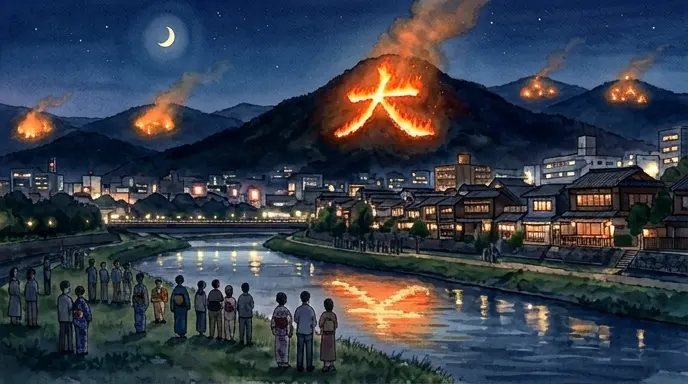
At 8pm on August 16th, five mountains surrounding Kyoto City are lit in turn. The characters ``Dai'', ``Myo'', and ``Ho'', the shape of a ship, and the shape of a torii gate appear on the mountain surface and disappear in about an hour. ``Gozan Okuribi'' is an event to send back the spirits of the ancestors who returned during Obon to the afterlife. It is known as a traditional feature that heralds the end of summer in Kyoto.
🔥 Order and position of the five Okuribi
Gozan Okuribi is lit in the following order.
20:00 Daimonji: Higashiyama/Nyoigatake. The character ``large''. It is the most famous of the Gozan Okuribi and is sometimes called ``Daimonjiyaki,'' but in Kyoto it is officially called ``Okuribi.''
20:05 Myoho - ``Myo'' in Matsugasaki's Nishiyama and ``Ho'' in Higashiyama. One group consists of two mountains. It comes from the Nichiren sect's Nam-myoho-renge-kyo.
20:10 Funagata - Funagata in Nishikamo. It is an okuribi in the shape of a ship. It symbolizes a spirit ship (a ship that carries the spirits of the dead and sends them to the afterlife).
20:15 Hidari Daimonji - Daimonji Mountain in Mt. Great Kita. It is called ``Hidaidaimonji'' to distinguish it from Higashiyama's ``Dai''.
20:20 Torii-shaped - Mandara Mountain in Saga. It is an okuribi in the shape of a torii gate. While the other four types burn firewood by assembling firewood, the torii type uses torches that are stuck into the ground, and the color of the flame is slightly reddish.
Points of appreciation
- Daimonji viewing spots:It can be seen directly along the Kamo River (near Demachiyanagi), on the east side of Kyoto Gyoen National Garden, and from Mt. Yoshida. The riverbed of the Kamo River (upstream part of the Kamogawa River) is a popular place among locals.
- View multiple Okuribi:The five Okuribi are located in different mountain positions, so you cannot see them all from one place. It is said that multiple Okuribi can be seen from the rooftops of tall buildings and Funokayama Park.
- Ignition time is short:Each mountain's Okuribi will go out in about 30 minutes after being lit. The viewing time is approximately 50 minutes from 20:00 to 20:50. If you are late, you will miss it.
- Don't call it "Daimonjiyaki":``Yaki'' has the connotation of ``burning something,'' and is avoided in Kyoto because it gives the impression that it downplays the religious meaning of okuribi. It is appropriate to call it ``Okuribi'' or ``Daimonji no Okuribi.''
- congestion:Space reservations will begin around 7pm along the Kamogawa River and around Demachiyanagi. Buses within Kyoto City are subject to significant delays, so traveling by subway and walking is the best option.
🌙 Kyoto after Okuribi
Once the Gozan Okuribi festival ends, summer in Kyoto comes to an end. Although the lingering summer heat is still severe, people living in Kyoto share the feeling that once the okuribi festival is over, preparations for autumn will begin. On the night of August 16th, after the mountain fires are extinguished, Kyoto is enveloped in a silence that contrasts with the hustle and bustle of the festival.
Gozan Okuribi is fixed on August 16th every year, and is generally held even on rainy days. In the event of heavy rain or typhoons, the scale may be reduced or the ignition time changed, but cancellations are extremely rare. If you are in Kyoto on August 16th, there is no need for reservations or fees as long as you arrive at the viewing location before 8pm.