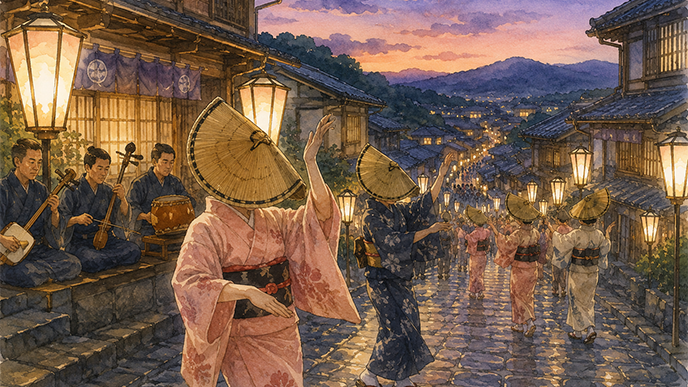
Yatsuo-machi, Toyama City, Toyama Prefecture, has just entered September. As the sun goes down, the sounds of kokyuu and shamisen begin to play from all over Sakano Town.
``Owara Kaze no Bon''. This is a three-day event that is representative of Toyama, where dancers wearing deep woven hats silently float through the town at night. In 2026, it will be held from September 1st (Tuesday) to September 3rd (Thursday).
🎐 A 300-year-old “calm the wind” festival
The origin of Owarakaze Bon is said to be 1702 (Genroku 15). It is said that it began when the town of Yao danced for three days and nights to celebrate the "Machiken Gosizuke" document that had been recovered from the Kaga clan. The name ``Kaze no Bon'' comes from the fact that it has the characteristics of a ``Fuuchinsai'' festival to calm the winds on the 210th day (210th day of spring, around September 1st) and pray for the harvest of rice. It is said to have been a prayer event to avoid damage from the wind before the typhoon season begins.
Owara's greatest feature is its tranquility. While other Bon dances are performed lively with drums and cheers, Owara is accompanied by live music from kokyu, shamisen, and taiko drums, and the dancers wear woven hats over their heads and dance silently without showing their faces. The melancholy sound of the kokyu and the restrained and graceful movements give an impression that is more like a dance than a Bon dance. Yao is a town of hills and cobblestones, and the lights of snow lanterns hanging in the alleys of houses with lattice doors add a unique atmosphere to this quiet dance.
The town of Yao is divided into 11 branches called ``Eleven Towns'', and each town has its own costumes, choreography, and dance sections. The dance is performed in a style called ``machi-nagashi'' in each town, and a group of performers and dancers slowly parade through the town. Approximately 250,000 tourists visit over the three days, while the town's population is approximately 19,000. The entire town becomes the stage for the festival.
Characteristics of each of the eleven towns
The colors of the costumes and the parts of the dance vary from town to town. One way to enjoy it is to compare them on the route that takes you through town.
| Town name | Features/Highlights |
|---|---|
| Higashimachi | The center of Yao. The scale of town-nagashi is large. |
| Nishimachi | A town facing the Ida River. The view of the cobblestone slope is beautiful. |
| Suwa Town | This cobblestone street was selected as one of Japan's 100 best roads. Popular as a photo spot. |
| Kamishinmachi | A calm townscape with rows of townhouses with lattice doors. |
| Kagamimachi | A former red light district. Known for the stage dance ``Otaya Kaidan no Odori''. |
| Shimosinmachi (Shimoshinmachi) | Monmyoji Temple opens its grounds to the public as a place for ring dances. |
| Tenma Town | A town around Tenmangu Shrine. It is characterized by its rustic town atmosphere. |
| Imamachi | The town is close to Yao Station, making it easy to access on your first day. |
| Nishishinmachi (Nishishinmachi) | A continuous townscape with Nishimachi. Good view of the snow cave at night. |
| Higashishinmachi | Adjacent to Higashimachi. Night-time streetwalks can last until late at night. |
| Fukushima | Yao station area. As soon as you arrive, you will be able to experience the town flow. |
Viewing points
These are the key points to enjoy Owara Kaze Obon.
- Time zone and town flow:The town parade in each town is generally held from around 15:00 to around 23:00. The time from dusk to night is the most atmospheric, and after 7pm when the snow caves are lit up, the entire town transforms into a fantastical scene. It will be canceled in case of rain.
- “Original appearance” after 11pm:After 11pm, when the official schedule ends, performers from each town may continue performing on their own. Owara, which is danced in the alleys late at night when there are fewer tourists, is said to be the original style of Kaze no Bon. This is the time when you can only experience it if you can find accommodation in Yao Town.
- Performance:A ``Enbu-kai'' will be held from 7:00 pm to 9:00 pm on a special stage at the Yao Elementary School grounds, where dances from each town will be performed in turn. Advance sales for paid reserved seats usually begin around June through JTB and other channels. It is also the only place where viewing is guaranteed.
- stay:There are very few accommodations in Yao Town, and the three-day stay is booked out almost a year in advance. Realistically, you will be staying in the center of Toyama City and commuting to Yao by special train or shuttle bus. During the festival period, a shuttle bus will be running between Toyama Station and Yao.
- Clothes:Yao is a town of hills and cobblestones, and the viewing experience involves walking around the alleys. Comfortable walking shoes are required. Nights in early September can get a little cold, so it's best to bring a light jacket.
Access to Yao
| Place of departure | route | Time required |
|---|---|---|
| Tokyo | Hokuriku Shinkansen "Kagayaki" → Toyama Station → JR Takayama Main Line | Approximately 2 hours 35 minutes |
| Osaka | Limited Express “Thunderbird” + Hokuriku Shinkansen → Toyama Station → JR Takayama Main Line | Approximately 3 hours 30 minutes |
| Nagoya | Take the limited express “Hida” to Toyama Station → JR Takayama Main Line | Approximately 4 hours 20 minutes |
| Toyama Station | Take the JR Takayama Main Line to Etchu-Yatsuo Station | Approximately 25 minutes |
🎋 What the tone of Kokyu conveys
The ``Kokyu'' is at the center of the Owara Kaze Bon music. It is a bowed string instrument shaped like a smaller shamisen, and the sound is produced by rubbing the strings with a bow. There are only a limited number of occasions in which the kokyu plays the leading role in Japanese traditional music, and Owara is also the festival that made the sound of the kokyu known throughout the country. The melancholy sound of the kokyu is also connected to the original character of the Obon event, which was meant to send away the dead. A prayer to calm the 210-day wind and a feeling of repose for the souls left over from the Obon festival flow beneath the tranquility of Owara.
Yao is a town that prospered during the Edo period due to the Toyama clan's medicine and sericulture industry. This economic foundation is why the cobblestone streets and houses with lattice doors remain today. The townscape itself functions as a stage setting for Owara. Many of the dancers were born and raised in Yao, and some towns have an age limit of 25 years. For local young people, dancing at Owara is like a rite of passage as a member of the town.
The number of 250,000 people over three days is unusual for a festival where people dance quietly. Even so, Owara continues to be a ``town festival'' rather than a ``festival for show'' because time is left at the heart of the festival for the local people, as symbolized by the voluntary town parade late at night. It is a festival that visitors should also respect as they walk through the festival.