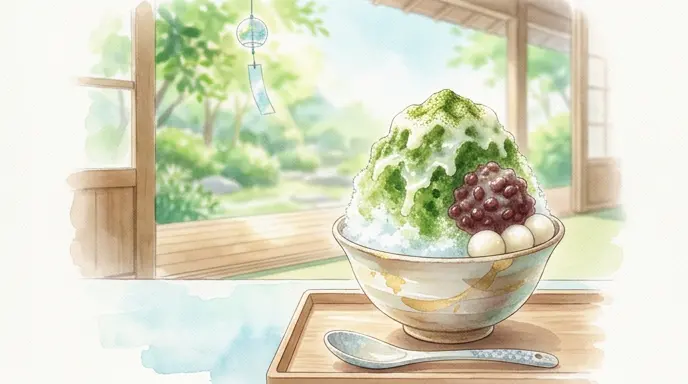
Kakigouri is a sweet that is indispensable for summer in Japan. It is one of Japan's oldest frozen desserts, made by shaving blocks of ice into thin pieces using a special machine and then pouring colored syrup over them. You can find shaved ice just about anywhere in Japan during the summer, from food stalls to sweet shops to cafes and convenience stores.
🍧 かき氷の歴史
Records of shaved ice date back to the Heian period. In Sei Shonagon's ``Makura no Soshi'' (late 10th century to early 11th century), there is a description of ``Putting amazura into shaved ice (kezurihi) and then putting it into new kanamari''. Amazura is a sweetener made from ivy sap, and is said to be the oldest known shaved ice in Japan.
In the Heian period, shaved ice was a luxury item that only the aristocrats could eat. This is because natural ice cut in the winter was stored in a storage facility called a Himuro, and then taken out and used in the summer. It wasn't until ice-making technology was introduced in the Meiji period that ordinary people became able to eat shaved ice.
There are two types of shaved ice today. One type is ``ennichikei,'' which is eaten at food stalls or at festivals, and is made of coarse, crunchy ice topped with colorful syrups such as strawberry, melon, and blue Hawaiian. The price is around 300 yen to 500 yen. The other type is the ``specialty store type'' that has been rapidly increasing in recent years, and is made by shaving natural ice or pure ice into extremely thin pieces and pouring plenty of homemade syrup, fruit, red bean paste, and condensed milk on top. Prices range from 800 yen to 2,000 yen, and at popular stores there can be lines of more than an hour.
Points to enjoy shaved ice
- Natural ice (tennengori):This ice is cut from the ice that forms on the surface of a lake or pond in winter and stored in an icehouse. There are remaining natural ice breweries in Nikko City, Tochigi Prefecture, Nagatoro Town, and Chichibu City, Saitama Prefecture. Natural ice has few impurities and is characterized by being soft like cotton when shaved. The number of stores with "Natural Shaved Ice" as their signboards is increasing all over the country.
- Standard syrup:Strawberries (red), melons (green), lemons (yellow), and Blue Hawaii (blue) are the staples at the food stalls. In fact, it has been pointed out that the taste of these syrups is not fruit juice but synthetic flavoring, and that the ``difference in taste'' is mainly due to the aroma and color. Many people like to sprinkle condensed milk on top.
- Uji Kintoki:Shaved ice topped with matcha syrup and grained red bean paste, this is a standard menu item at Japanese sweets restaurants. "Kintoki" means anko (red bean). Sometimes condensed milk or vanilla ice cream is added.
- "Ice" flag:The sign of a shop selling shaved ice is a flag with the word "ice" written in red on a white background. This flag with a wave pattern is part of the Japanese summer landscape. If you see one, there's probably a shop nearby where you can eat shaved ice.
🏮 夏の甘味いろいろ
In addition to shaved ice, there are other cold sweets that are unique to Japan's summer. Mizu Youkan is a cold yokan made with agar and red bean paste, and has a smoother texture with more water than regular yokan. Kuzukiri is made by hardening arrowroot powder, cutting it into thin pieces, soaking it in cold water, and eating it with brown sugar syrup. ``Anmitsu'' is a sweet dish made with agar, red bean paste, gyuhi, and fruit, and ``Cream Anmitsu'' with matcha ice cream is a popular menu item at sweets shops.
In Japan in August, there are many days when the temperature exceeds 35℃. When you're tired of walking around sightseeing, eating shaved ice at a sweet shop or cafe is a practical way to beat the heat. Please look for the store using the "ice" flag as a landmark. Whether it's the 300 yen shaved ice at a food stall or the 1,500 yen shaved ice at a specialty store, it's one way to experience summer in Japan.