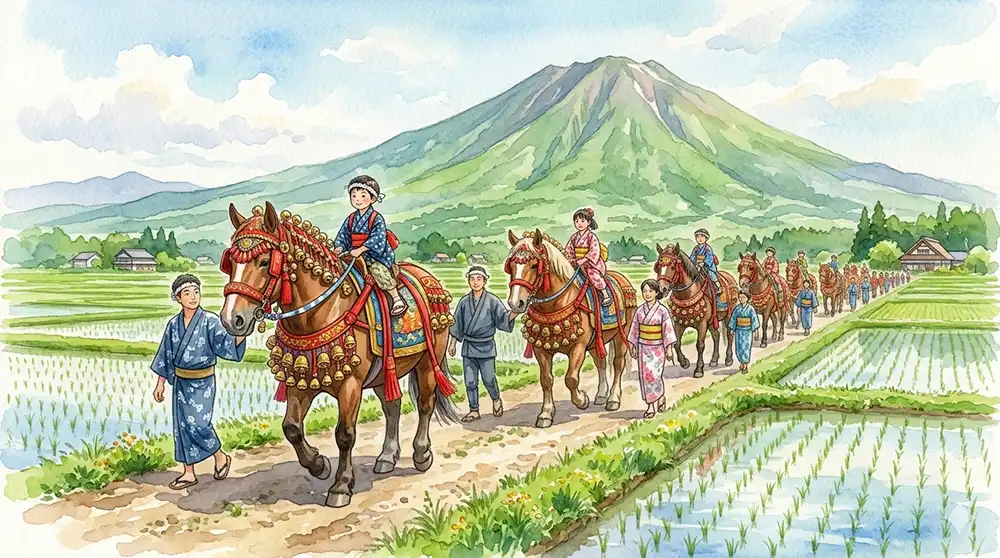
On June 13th, a procession of horses wearing brightly colored costumes walks along a 14km road from Takizawa City in Iwate Prefecture to Morioka City.
"Chagu Chagu Umakko" is a traditional event in Iwate Prefecture that was born out of gratitude for agricultural horses. It has been designated as a national important intangible folk cultural property. The name of this event comes from the sound that the countless bells attached to the horses' bodies make when they walk.
🐴 A procession where the sound of bells was selected as one of Japan's top 100 soundscapes
At the Chagu Chagu Umako, about 60 horses walk around wearing gorgeous red and gold costumes and wearing hundreds of bells from head to tail. The sound of the bells has been selected by the Ministry of the Environment as one of Japan's 100 Best Soundscapes to Preserve, and the sound of 60 bells ringing in unison lets you know that a procession is approaching, even from far away.
The procession departs from Onikoshi Sozen Shrine in Takizawa City in the morning and walks for about four hours to Morioka Hachiman Shrine in Morioka City. Children are often riding the horses, and locals and tourists gather along the route.
The origin of Chagu Chagu Umako lies in the ``Aozen Shrine'' where agricultural horses are brought to worship at Aozen Shrine to pray for good health. In the Tohoku region, horses were indispensable for agricultural work. To express our gratitude to the horses that plowed the fields, carried cargo, and supported the lives of farmers, once a year we dress up the horses and take them to the shrine. This custom developed into the current Chagu Chagu Umako.
Points of appreciation
This is the point to see Chugu Chagu Umako.
- Departure ceremony:A departure ceremony will be held at Onikoshi Sozen Shrine in the morning. The moment the horses start moving all at once is one of the highlights, as the sound of bells echoes throughout the grounds. You can also see the horse's costume up close before departure.
- Root of matrix:Walk about 14km from Onikoshi Sozen Shrine (Takizawa City) to Morioka Hachimangu Shrine (Morioka City). It can be viewed from anywhere along the route, but the section after entering Morioka city is crowded with people, especially when arriving at Morioka Hachimangu Shrine.
- photograph:The procession of costumed horses is especially picturesque when set against the backdrop of rice fields and mountains. The countryside before entering Morioka city is a beautiful spot for landscape photos.
- access:The departure point, Onikoshi Sozen Shrine, is approximately 10 minutes by taxi from JR Takizawa Station. The destination, Morioka Hachimangu Shrine, is approximately 15 minutes by bus from JR Morioka Station. It takes about 2 hours and 15 minutes from Tokyo to Morioka on the Tohoku Shinkansen.
🔔 Memories of living with horses in Tohoku
Horses were once part of the family in rural areas of the Tohoku region. The traditional farmhouse architecture of Iwate Prefecture, called ``Nanbu Magari-ya,'' has an L-shaped structure in which people's residences and horse stables are connected. It is a remnant of the days when people and horses lived under the same roof.
As agriculture has become more mechanized, farm horses have disappeared from daily life, but on Chagu Chagu Umako Day, horses dressed in costumes walk through the streets of Morioka. A procession of horses and the sound of bells moving through the countryside with Mt. Iwate in the background. If you have a chance to travel to Tohoku in June, this event will be one of the reasons to visit Morioka.