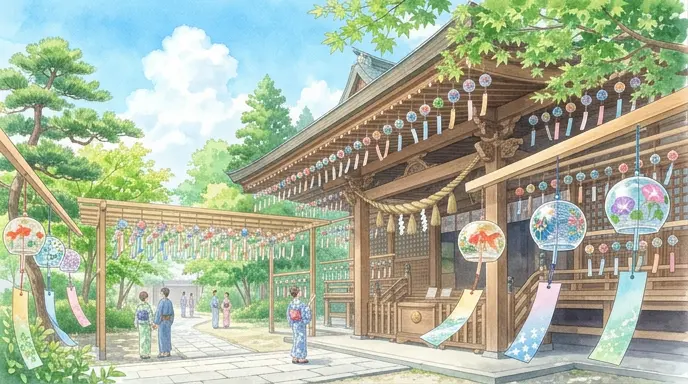
When you visit Japanese temples and shrines in the summer, you may come across hundreds to thousands of wind chimes (Furin) hanging in the temple grounds, ringing all at once every time the wind blows. Wind chimes are one of the tools that represent summer in Japan, and are small bells made of glass, metal, or ceramics. Although it has a simple structure that generates sound when it catches the wind, Japanese people say that listening to this sound makes them feel cool.
🎐 風鈴の歴史――魔除けから涼の道具へ
The origin of wind chimes lies in the Chinese ``senfuutaku''. Bronze bells were hung in bamboo groves to predict good or bad luck based on the direction and sound of the wind. It was introduced to Japan along with Buddhism and was used as a ``fuutaku'' that was hung from the eaves of temples. There is a belief that those within the reach of the sound of the wind chime will be protected from misfortune, and this is the origin of the current wind chime.
When glass manufacturing technology became popular during the Edo period, "glass wind chimes" (violet wind chimes) became popular among the common people. In particular, Edo Furin (Edo Fuurin) are handmade one by one using glass blowing techniques, and are still being produced by craftsmen in Tokyo. It is characterized by painting from the inside of the glass, and summer patterns such as goldfish and morning glories are drawn on it.
There is some scientific evidence that the sound of wind chimes makes you feel cool. It is said that by repeating the experience that wind chimes ringing = wind blowing, a conditioned reflex is formed in the brain that responds to ``coolness'' just by hearing the sound. However, some research reports show that this reaction is more pronounced in people who grew up in Japan, and that the same effect is less likely to occur in people who are not familiar with wind chimes.
2026 Wind Chime Festival/Wind Chime Spots
- Kumano Taisha “Kanade” (Nanyo City, Yamagata Prefecture):June 1st to September 30th. Wind chimes are hung in the precincts of old shrines in Tohoku. About 10 minutes by bus from JR Akayu Station.
- Hakusan Shrine “Tanabata Wind Chime Festival” (Niigata City, Niigata Prefecture):June 10th to July 20th. Approximately 2,000 wind chimes are lined up at Hakusan Shrine, the main shrine of Niigata. Approximately 15 minutes by bus from JR Niigata Station.
- Gosen Hachimangu Shrine “Tanabata Wind Chime Festival ☆ Milky Way Tour” (Gosen City, Niigata Prefecture):June 30th to August 9th. This is an exhibition of wind chimes that make the shrine grounds look like the Milky Way. About 15 minutes walk from JR Gosen Station.
- Houtokuji “Wind Chime Festival” (Kiryu City, Gunma Prefecture):June 27th - September 23rd. Approximately 4,000 wind chimes fill the grounds. This temple is also known for its toko mapiji (the reflection of autumn leaves on the floor). Approximately 10 minutes by taxi from Omama Station on the Watarase Keikoku Railway.
- Enshu Sanzan Wind Chime Festival (Fukuroi City, Shizuoka Prefecture):~August 23rd (Hotayama until August 31st). This is a wind chime festival that goes around three temples: Mt. Hota, Kasuisai, and Aburayama. From JR Fukuroi Station, take a bus to each temple.
- Nanrakuen National Furin Festival (Uwajima City, Ehime Prefecture):June 27th to August 23rd. This exhibition collects wind chimes from all over the country, allowing you to compare the differences in wind chimes from region to region. Approximately 20 minutes by bus from JR Uwajima Station.
- Shinshu Iijima Kaze Road Rinrin Festival (Iijima Town, Nagano Prefecture):Only for one day, August 11th. It will be held in the town of Shinshu, located between the Central and Southern Alps. Around JR Iijima Station.
🏠 日本の「涼をとる」文化
Wind chimes are a part of Japan's "cooling down" culture. Before air conditioners became widespread in Japan, various ideas were invented to beat the summer heat. They are uchimizu (sprinkling water on the ground to lower the temperature through heat of vaporization), blinds (shades made of bamboo or reeds), mosquito coils, and wind chimes. These are still sold at convenience stores and home centers, and continue to be used as summer tools in Japan.
Wind chime festivals are held at temples and shrines across the country from June to September. The only way to experience the sound of thousands of wind chimes chiming in the wind is to visit the place in person. Hearing the sound of wind chimes in the quiet space of a temple or shrine is a unique way to experience summer in Japan through sound.