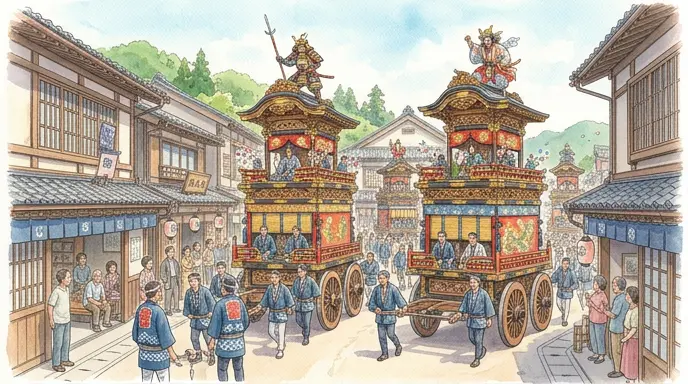
Murakami City, Niigata Prefecture (Murakami-shi) is a castle town located along the Sea of Japan, about 100 kilometers north of Niigata City. Murakami Taisai is held every year on July 6th and 7th in this town of approximately 55,000 people. In 2026, the evening festival will be held on July 6th (Monday), and the main festival will be held on July 7th (Tuesday).
🏯 “Oshagiri” tours the castle town
The main attraction of the Murakami Festival is the food stalls (dashi floats) called ``Oshagiri.'' Nineteen stalls decorated with lacquer and decorated with gold leaf and carvings parade through the narrow streets of the castle town. The stall is approximately 5 meters high, and the top is decorated with dolls representing historical military commanders and mythological figures.
This festival is said to have been started in 1633 by the lord of the Murakami domain as a festival at Senami Haguro Jinja Shrine. It has a history of about 390 years and is designated as an intangible folk cultural property of Niigata Prefecture.
On July 7th, the main festival, 19 Oshagiri floats will depart from each town early in the morning and cruise around the center of town. The scene where large food stalls pass through the narrow alleys typical of castle towns is impressive, and the technique of turning corners is one of the highlights. From evening onwards, the lanterns are lit, creating a different atmosphere than during the day.
Viewing points
- Cruise route:The 19 Oshagiri floats depart from each town and travel around the city center. Because the distance between the eaves of the townhouses and the food stalls is very close, it is more impressive to see them on narrow streets.
- Evening Festival (July 6th):From the evening, lanterns are lit at Oshagiri. The sight of illuminated stalls moving through the streets of townhouses after sunset has a quiet beauty that is different from the main festival.
- Murakami townhouse:Murakami City is an area where townhouses from the castle town still remain. The ``Machiya Doll Tour'' is held every March, and the ``Machiya Folding Screen Festival'' is held in autumn, and the historic townscape itself is a tourist resource.
- access:It is about a 15 minute walk from JR Murakami Station to the center of the festival. It takes about 1 hour and 10 minutes from Niigata Station on the JR Uetsu Main Line. From Tokyo, it takes about 2 hours to get to Niigata Station on the Joetsu Shinkansen, and it takes about 3 and a half hours in total including transfers.
🐟 Murakami's salmon culture
Murakami City is also known for its salmon culture. The salmon caught in the Miomote-gawa River is famous as ``Murakami's salmon,'' and during the Edo period, it was recorded as the first place in the world to successfully hatch and multiply salmon naturally. There are many restaurants and cafeterias in the city that serve salmon dishes, and the sight of ``Shiobiki-zake'' (dried salmon) hanging from the eaves is a winter tradition in Murakami.
If you visit Murakami for the July festival, be sure to walk through the townhouses of the castle town and check out the shops selling processed salmon products. Not only the festival stalls, but the town itself is a tourist destination with a history. It is possible to visit Murakami on a day trip from Niigata city, but if you stay overnight you will be able to see both the evening festival and the main festival. Senami Onsen is a hot spring town facing the Sea of Japan, located about 10 minutes by bus from Murakami Station.