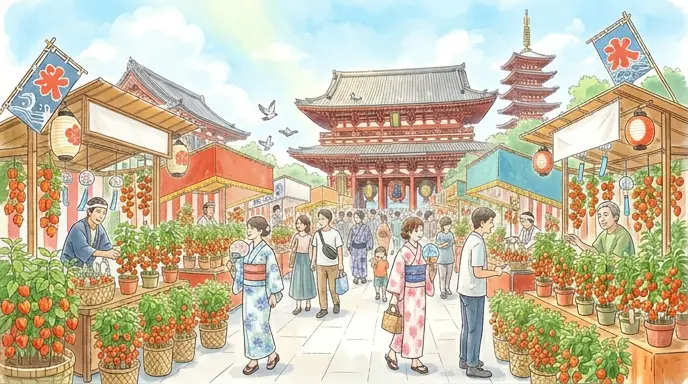
For two days on July 9th and 10th every year, the precincts of Sensou-ji Temple in Tokyo are filled with potted Hoozuki plants. Approximately 100 stalls are lined up, and bright orange cherry blossoms decorate the grounds. These two days are a special festival at Sensoji Temple called Shimanrokusen-nichi (Shimanrokusen-nichi), and it is said that if you visit the shrine on these days, you will receive 46,000 days worth of blessings (approximately 126 years' worth).
🏮 Origin of 46,000 days
At Sensoji Temple, Kannon Bodhisattva's Kudokubi days (special days when the merit of worshiping increases) are set several times a year. July 10th is said to be the day with the greatest merit, giving it the name ``46,000 days.'' The day before, July 9th, is said to have the same merits, so the fair is held for two days.
The history of 46,000 days dates back to the mid-Edo period (18th century). It is said that it originally started as a ``1000-day pilgrimage,'' and the number of days for meritorious deeds gradually increased until it reached the current 46,000 days.
It was in the late Edo period that Hozuki City was associated with Shi60000 Days. Originally, Hoozuki was sold during the thousand-day pilgrimage at Atago Jinja, but Sensoji Temple took this in and it became the current ``Hoozuki Market.''
Hozuki City experience points
- Price of scallops:The standard price for potted Chinese cherries (including a wind chime) is 2,500 yen per pot. There are also scallops with branches in bamboo baskets (about 1,000 yen).
- Lightning protection:The "thunder protection" amulet awarded on this day is a lucky charm that is only available for 46,000 days. It has the meaning of warding off lightning and disasters.
- Event time:The Hozuki market will be held from 8:00 a.m. to 9:00 p.m. on both days. Special visits to the main hall of Sensoji Temple are relatively free in the early morning hours.
- access:Approximately 5 minutes' walk from Asakusa Station on the Tokyo Metro Ginza Line, approximately 7 minutes' walk from Asakusa Station on the Toei Asakusa Line. Pass through Nakamise Street and enter the shrine grounds.
- congestion:Approximately 600,000 people visit over the two days. It gets crowded especially after evening. Visitors can be seen relatively slowly during the early hours of the day.
🧡 ほおずきとは何か
Hoozuki (scientific name: Physalis alkekengi) is a perennial herb belonging to the Solanaceae family, and has a round fruit inside an orange bag-shaped calyx. In Japan, it is also known as a plant that is offered at Buddhist altars and in front of graves during the Obon period, and because the shape of the calyx resembles a lantern, it is thought to be a light that guides the spirits of ancestors.
The Hozuki Market at Sensoji Temple is a traditional event that heralds the beginning of summer in Tokyo. The souvenir shops on Nakamise Street and surrounding restaurants are also open until late at night, allowing you to enjoy the atmosphere of Asakusa's downtown area. Temperatures in Asakusa in July often exceed 30℃, so be sure to stay hydrated and take precautions against the sun.