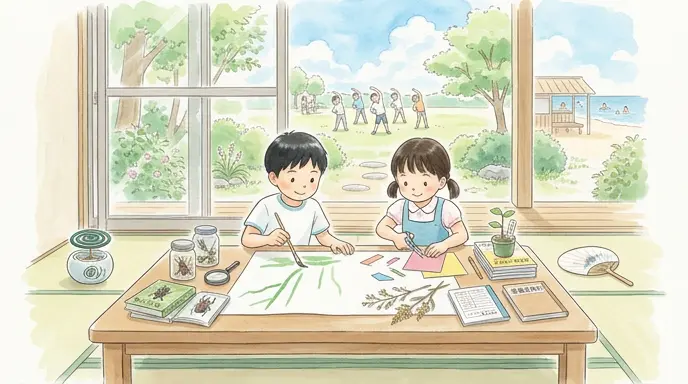
Summer vacation for elementary school to high school students in Japan lasts approximately 40 days from late July to the end of August. The start and end dates differ depending on the region, with Hokkaido having a short summer vacation and some schools having a fall vacation from late July to mid-August (approximately 25 days), and Okinawa having a short summer vacation. These approximately 40 days are the longest vacation of the year for Japanese children, and they create a variety of scenery that forms the Japanese summer culture.
📚 Homework and independent research
During summer vacation in Japan, there is a large amount of homework. These are drills (problem collections) for Japanese, arithmetic, science, and social studies, book reviews, picture diaries (for lower grades), and "independent research." Independent research is an assignment in which children decide on their own theme, conduct research, experiment, and produce, and then submit the results.
The theme of independent research is free. ``Investigating the water quality of a nearby river,'' ``Investigating the types of cicada shells,'' ``Interviewing grandparents and summarizing family history,'' ``Taking pictures of cloud formations every day,'' and so on, vary depending on the child's interests and family circumstances. The traditional format is to submit all applications on large blank sheets of paper, which are posted in classrooms and hallways during the new semester.
The act of ``completing your summer vacation homework on the last day'' is said to be a common childhood experience among Japanese people. At the end of August, bookstores carry special features on ``How to Write a Book Review,'' and stationery stores sell independent research kits.
Japanese summer vacation scenery
- Radio gymnastics (Rajio Taisou):It is customary for children to gather at nearby parks and squares at 6:30 in the morning during summer vacation and do gymnastics along with the NHK radio gymnastics program. A stamp will be stamped on your attendance card, and if you attend perfectly, you will receive a prize. It started in 1928 and continues today.
- Sea bathing:The swimming season is from mid-July to the end of August. The beach is lined with temporary rest areas and restaurants called ``Uminoie''. It is a simple building with showers, changing rooms, float rentals, and sales of fried noodles and curry rice, and is only open during the swimming season.
- Pool:The public outdoor pool is only open during the summer holidays. In some areas, elementary school pools are open to the public, and it is customary for parents to act as ``pool watchers.''
- Insect repellent:Catching beetles and stag beetles is a classic summer game for Japanese children. Early in the morning or at night, they look for trees that produce sap, find insects, put them in insect cages, and take them home. Beetles are also sold at home centers and pet stores.
- Homecoming for Obon:Visiting their grandparents' house during summer vacation for Obon is one of the highlights of summer vacation for children. Spending a few days in the countryside is a vivid summer memory that many Japanese people remember even as adults.
🌻 Feeling of “end of summer”
In late August, the sounds of cicadas in Japan gradually change. The sound of the Japanese cicadas and cicadas in July changes to the chirping of the cicada cicadas in late August, and many Japanese people feel that summer is over when they hear this. Dusk is gradually getting earlier, and the sounds of autumn insects (crickets and ground beetles) begin to mix into the night.
The last day of summer vacation is the most depressing day of the year for Japanese children. My impatience with my unfinished homework and my sadness at the end of my long vacation overlap. If you are traveling in Japan at the end of August, you may see parents and children hurriedly shopping at stationery stores or children frantically reading books at libraries.