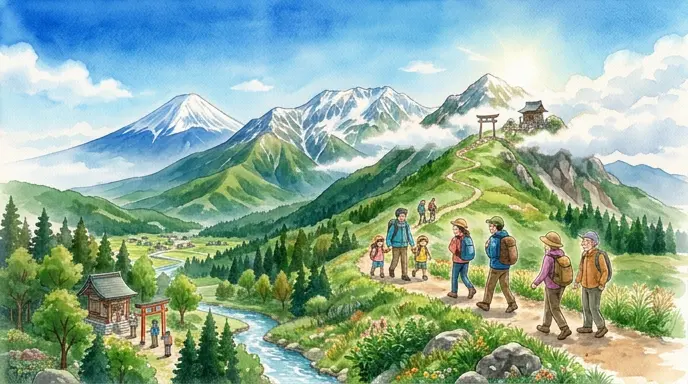
August 11th is "Yama no Hi". It is Japan's newest national holiday, established in 2016 with the purpose of giving people the opportunity to get closer to the mountains and appreciate their blessings. Originally, there were no holidays in August, and by placing the holiday just before the Obon holiday (August 13th to 16th), it was intended to make it easier to take a long vacation.
⛰️ 8月11日の背景
There is no specific mountain-related historical event on August 11th. Initially, August 12th was the candidate date, but because this day coincides with the day of the Japan Airlines Flight 123 crash in 1985, it was changed to the previous day, August 11th. There is an explanation that ``8'' is likened to the shape of a mountain, and ``11'' is likened to two trees lined up, but this is an afterthought.
Approximately two-thirds of Japan's land is mountainous. The Japanese people have a deep relationship with mountains, and their culture of worshiping mountains has continued from ancient times to the present day. Mt. Fuji, Mt. Tateyama, and Mt. Hakusan are called ``Japan's Three Sacred Mountains,'' and the mountains themselves have been worshiped as sacred objects.
Key points to understand Japanese mountain worship
- Shugendo (Shugendou):It is a unique Japanese religion in which people gain supernatural powers through rigorous training in the mountains. It is a belief system that combines Shinto and Buddhism, and its practitioners are called ``Yamabushi''. The Gohan style at Rinnoji Temple in Nikko, which I introduced in my April article, also originates from Shugendo.
- Mt. Fuji and religious mountaineering:The climbing season for Mt. Fuji is from early July to early September. It has been the subject of religious mountain climbing since ancient times, and even today there is an inner shrine of Sengen Taisha Shrine at the summit. The number of climbers per year is approximately 200,000.
- Events held on Mountain Day:Commemorative mountain climbing and events will be held at various mountains. However, there is no specific large-scale festival, and since it has a short history as a holiday, the established custom of ``doing this on this day'' is still in the process of forming.
- Connection with Obon:The holidays start on August 11th (Mountain Day), then the 12th, and then the 13th (Welcome Fire), so many companies will have a six-day holiday from the 11th to the 16th. During this period, Shinkansen, airplanes, and expressways reach their peak congestion.
🗻 「山」がつく日本語と日本人の山への意識
There are many expressions derived from mountains in Japanese. Mountains are naturally incorporated into everyday conversations, such as ``Yamaba = the most important situation'', ``Yama wo Haru = predicting the outcome and betting on it'', ``There are mountains and valleys'' (Yamaarita Niari = the ups and downs of life), and ``Oyama no Taisho = a person who takes pride in a small world''.
Mountain Day is not yet well known as a national holiday, and many Japanese people cannot immediately answer what they do on it. However, the fact remains that Japan's land is covered in mountains, and that mountains are deeply connected to both religion and daily life. If you're in Japan on August 11th, be sure to take in the views from nearby mountains and observation decks. The mountains are greenest in summer, giving them a vibrant appearance that is different from the snowy mountains of winter or the autumn leaves.