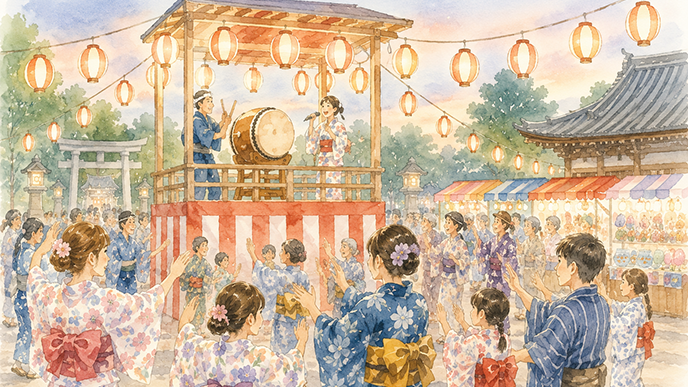
During Obon, yagura (turrets) are erected and lanterns are hung in the grounds of parks and temples and shrines all over Japan. As the sun sets, the sound of drums begins to echo and people dance in a circle around the turret. Bon Odori (Bon Odori) is a dance that began to comfort the spirits of our ancestors, and is a symbol of summer nights in Japan.
🪘 History and form of Bon Odori
The origin of Bon Odori is said to be in the ``Odori Nenbutsu,'' which was popularized by Ippen Shonin, the founder of the Jishu sect, in the Kamakura period (13th century). It was a religious act in which people prayed for heavenly bliss by dancing while chanting Nembutsu, but it eventually became established as a folk entertainment and spread throughout the country as a dance to welcome and send away the spirits of ancestors during the Obon period.
The basic format of Bon Odori is to build a turret in the center of a plaza, on which a person who plays the drum and a singer who leads the dance perform while the people around them form a circle and dance. The choreography of the dance differs from region to region, but it consists of a combination of basic movements such as raising and twirling the hands, moving forward and lowering, and clapping, so even first-timers can participate while observing their surroundings.
Typical Bon dance songs include ``Tokyo Ondo,'' ``Tankobushi,'' and ``Kawachi Ondo.'' In recent years, songs such as ``Doraemon Ondo'' and anime theme songs arranged for Bon Odori have been played, and efforts have been made to encourage children's participation.
Bon dance experience points
- How to participate:As a general rule, anyone is free to participate in the Bon Odori. It is common for people to watch from outside the circle and join the circle once they understand the dance moves. There is no problem even if you make a mistake in the choreography.
- Venue:Large-scale events include the Bon Odori at Tsukiji Honganji Temple in Tokyo (early August), the Roppongi Hills Bon Odori, and summer festivals at parks and shrines around the country. Smaller events are held in parks in residential areas or in neighborhood association plazas, which give a more local atmosphere.
- stall:There are often food stalls set up around the Bon Odori venue. Typical dishes include yakisoba, shaved ice, cotton candy, goldfish scooping, and shooting.
- Time zone:Bon odori usually begins after sunset and ends around 9:00 p.m. In residential areas, due to noise considerations, the service may end around 8pm.
👘 Yukata - Japanese summer formal wear
Many Japanese people wear a yukata (yukata) when they go to Bon dances or fireworks displays. A yukata is a simple summer kimono made of cotton or linen, and can be worn by one person relatively easily, without the need for complicated obi ties or undergarments like a kimono.
As the name ``Yukata'' suggests, it was originally a garment worn after taking a bath. It is said to have its origins in the ``yukatira'' worn by aristocrats during the Heian period when taking a steam bath, and became established as summer outing clothing for commoners during the Edo period.
The price of a ready-made yukata ranges from 3,000 yen to 15,000 yen. At rental shops in tourist areas, you can rent a set of yukata, obi, and geta for around 3,000 to 5,000 yen. It also includes kimono dressing, so there's no problem even if you don't know how to put it on. There are many rental shops in tourist areas such as Kyoto, Asakusa, and Kamakura.
Wearing a yukata and joining the Bon Odori circle is one of the most direct ways to experience a Japanese summer night. Depending on the inn or hotel you are staying at, you may be provided with a yukata to wear inside the hotel. In hot spring towns, it is common to go out in a yukata, and the sight of tourists walking around town in yukata is a daily sight in hot spring resorts.