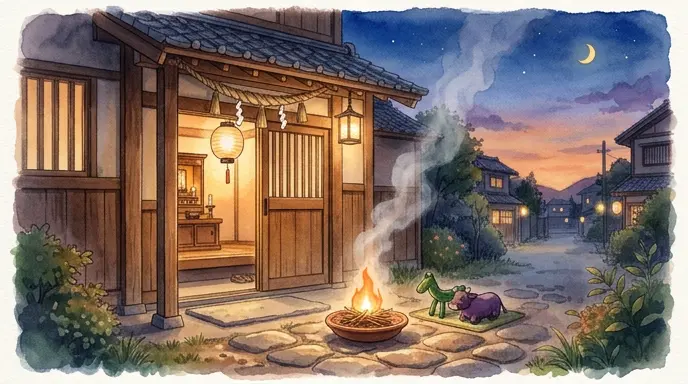
On the evening of August 13th, small fires are lit at the doorsteps of homes across Japan. This act of placing ``ogara'' (dried hemp stalks) on a clay plate and lighting it is called ``Mukaebi.'' It is said that the spirits of ancestors who return during Obon use this smoke as a landmark to return home.
🔥 お盆とは何か
Obon is the period when the spirits of our ancestors return from the other world to this world once a year. Officially called ``Urabon-e,'' it is said to derive from the Sanskrit word ``ullambana,'' which means the agony of hanging upside down. It originates from a Buddhist story in which a disciple of Buddha, Mokuren, held a memorial service to relieve the suffering of his deceased mother.
Currently, Obon is generally celebrated from August 13th to 16th, but in some areas of Tokyo and Hokkaido, it is celebrated from July 13th to 16th, which is closer to the lunar calendar. Obon in August is sometimes called ``Tsukudari Obon,'' and Obon in July is sometimes called ``Shinbon.''
Many businesses close during the Obon period, and a large number of people return to their hometowns for the Obon holiday. Around August 13th is one of the busiest times of the year for Shinkansen, airplanes, and expressways.
Points to understand about Obon customs
- Welcome fire and okuribi:On the evening of August 13th, we light a fire to welcome our ancestors, and on August 16th, we light an Okuribi to send our ancestors back. Kyoto's Gozan Okuribi (detailed in the next article) is a city-wide ``okuribi'' festival.
- Spirit horse (Shouryo-uma):Stick disposable chopsticks into a cucumber to make a ``horse,'' and stick chopsticks into an eggplant to make a ``cow,'' and offer them in front of the Buddhist altar. The cucumber horse means that the spirits of the ancestors can return quickly, and the eggplant cow means that they can return to the afterlife slowly.
- Bon-dana:A small altar (bondana or spirit altar) is made in front of the Buddhist altar, and fruits, sweets, somen noodles, and the deceased's favorite foods are placed there. In some regions, water is poured onto lotus leaves to create ``Akamizu.''
- Visiting the grave:During the Obon period, families visit cemeteries, clean gravestones, and offer incense and flowers. Many families go on the 13th or 14th.
- Impact on Obon and tourism:During the Obon period, many tourist spots are crowded, and accommodation prices are 1.5 to 3 times the normal price. On the other hand, there are fewer people in business districts in urban areas, creating a quieter atmosphere than usual. Many restaurants will be closed, so travelers should check in advance.
🏡 帰省ラッシュと「ふるさと」
Returning home for Obon is the biggest traveling event of the year for Japanese people, along with New Year's. People who live in urban areas return to their hometowns, and their families gather for meals and visit graves. Every year, TV news reports on Shinkansen ridership and expressway congestion forecasts.
The word "Furusato" (hometown) is deeply connected to the emotions of the Japanese people. In Japan, where the population is increasingly concentrated in cities, many people live in different places than where they were born and raised, and Obon and New Year are one of the few opportunities to return to your hometown. If you travel to rural areas during Obon, you may see families returning to normally quiet villages and cemeteries lined with flowers.