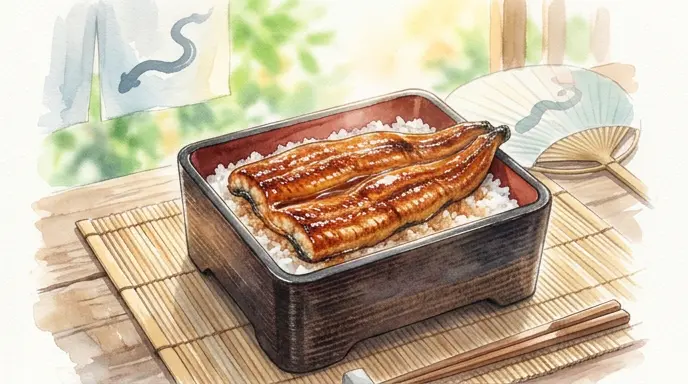
Sunday, July 26, 2026 is “Doyou no Ushi no Hi”. On this day, eel restaurants, supermarkets, convenience stores, and even gyudon chain stores all over Japan feature ``eel,'' and Japanese people eat kabayaki (grilled eel). It is said that about 30% of the annual eel consumption is concentrated during this period.
🗓️ 「土用の丑の日」とは何か
"Doyo" refers to the approximately 18 days that mark the change of the four seasons. There is a Doyo just before the first day of spring, first summer, first autumn, and first winter, but now when we say ``Doyo'' we generally refer to the summer Doyo (about 18 days before the first day of autumn). The first day of autumn in 2026 will be around August 7th, so the summer doyo period will be from around July 20th to around August 6th.
“Oshi no Hi” is a date that is counted according to the zodiac signs (child, ox, tiger, rabbit, etc.) and occurs once every 12 days. The day of the ox that occurs during the summer Doyo period is ``Doyo no Ushi no Hi.'' In 2026, this will be July 26th. Depending on the year, there are two ox days during the Doyo period, and the second day is called ``Ninoushi''.
The most widely known origin of the custom of eating eel on this day is an anecdote by Hiraga Gennai, a Dutch scholar from the Edo period. It is said that Gennai, who was asked by an eel restaurant who was complaining about not having customers in the summer, suggested putting up a sign that read ``Today is Ox Day,'' which became popular. However, there is no reliable historical support for this anecdote, and although it is a "established theory," it is not a "confirmed fact."
Eel experience points
- How to eat Kabayaki:Eel kabayaki is grilled eel that is opened and grilled over charcoal while being coated with sweet and spicy sauce. Common ways to eat it are ``Unaju'' or ``Udon'', which is ``Unadon'', which is ``Unadon'', which is ``Unaju'', which is ``Unadon'', which is ``Unaju'', which is ``Unadon'', which is ``Unadon'', which is ``Unaju'', which is ``Unadon'', which is ``Unadon'', which is ``Unaju'' or ``Udon''. The difference is that Kanto-style meat is tender because it is steamed and then grilled, while Kansai-style meat is grilled directly without steaming, so the skin is fragrant.
- price:Unaju at specialty stores generally ranges from 3,000 yen to 6,000 yen. At long-established stores, prices can exceed 10,000 yen. At supermarkets, one piece of kabayaki is sold for around 1,500 yen to 3,000 yen. In recent years, prices have been on the rise due to a decrease in the catch of young eels (glass eels).
- Famous eel production areas:Hamamatsu (Shizuoka Prefecture), Isshiki (Nishio City, Aichi Prefecture), Yanagawa (Fukuoka Prefecture), and Narita (Chiba Prefecture) are known as production areas. There are many eel restaurants along the approach to Naritasan Shinshoji Temple, and you can also visit them in conjunction with the Narita Gion Festival (July 10th to 12th).
- “Ushi Day” sales campaign:Doyo no Ushi no Hi is one of the biggest food sales seasons in Japan. Convenience stores will be selling eel on a pre-order basis, and the fresh fish section of supermarkets will be filled with eel. The sales competition on this day is on a scale comparable to Valentine's Day chocolates and Setsubun ehomaki.
🐟 うなぎの資源問題
When discussing Japan's eel culture, we cannot avoid the issue of resources. The Japanese eel (Anguilla japonica) was classified as "Endangered (IB)" on the International Union for Conservation of Nature (IUCN) Red List in 2014. The amount of wild eel caught has decreased significantly since its peak in the 1960s, and the majority of eel currently consumed in Japan is farmed.
In recent years, research into complete aquaculture (techniques for raising fish from eggs to adults in an artificial environment) has progressed, but commercialization has not yet been achieved. Against the backdrop of rising eel prices, there is a movement to ``eat foods with the ``U'' character other than eel (such as pickled plums, udon, and gourds) on the 2020 Ox Day.
If you're visiting Japan during the ox day, try eating kabayaki at an eel restaurant. Some restaurants allow you to enter without a reservation, but there are often long lines on the day of the ox, so one option is to visit the day before or the next day. The food culture based on the calendar called ``Doyo no Ushi no Hi'' is a custom that clearly shows the relationship between Japanese people and the calendar.