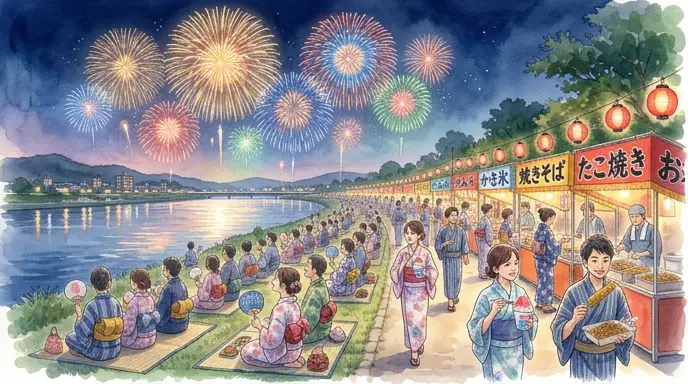
In Japan, fireworks festivals are held at more than 1,000 locations across the country from July to August every year. Japan has a culture of ``watching'' fireworks rather than ``setting them off,'' and the sight of hundreds of thousands of people sitting on riverbeds or beaches looking up at the sky is an iconic summer scene in Japan.
🎆 日本の花火の歴史
Fireworks became popular in Japan during the Edo period. Ryogoku Kawabiraki, held on the Sumida River in 1733, is said to be the origin of the largest fireworks display on record. The year before, there was a great famine and epidemic, and fireworks were set off to commemorate the victims and pray for the plague to go away.
During the Edo period, two fireworks master families, Kagiya and Tamaya, competed in their fireworks over the Sumida River. The custom of spectators calling out ``Tama-ya!'' and ``Kagiya!'' every time fireworks go off comes from this performance. Even today, there are people who shout "Tama-ya" at fireworks displays.
A characteristic of Japanese fireworks is that they open in a spherical shape. In many countries around the world, fireworks spread out irregularly in the sky, but Japanese fireworks are designed to spread evenly into a spherical shape. The beauty of this "perfect circle" is the core of the Japanese fireworks artist's technique. At competitive fireworks displays, the accuracy of the perfect circle, the vividness of the colors, and the beauty of the edges of the fireworks are judged.
Main fireworks festivals in 2026
| Sumida River Fireworks Festival | Saturday, July 25th | Approximately 20,000 rounds | Taito Ward/Sumida Ward, Tokyo |
| Gion Kashiwazaki Festival Sea Fireworks Festival | Sunday, July 26th | Approximately 16,000 rounds | Kashiwazaki City, Niigata Prefecture |
| Katsushika Noryo Fireworks Festival | July 28th (Tuesday) | Approximately 20,000 rounds | Katsushika Ward, Tokyo |
| Matsue Suigo Festival Lake Fireworks Festival | August 1-2 | Approximately 21,000 shots in total over 2 days | Matsue City, Shimane Prefecture (on Lake Shinji) |
| Ashikaga Fireworks Festival (110th anniversary) | Saturday, August 1st | Approximately 20,000 rounds | Ashikaga City, Tochigi Prefecture (Watarase River bank) |
| Nagaoka Festival Fireworks Festival | August 2-3 | Approximately 20,000 rounds | Nagaoka City, Niigata Prefecture (Shinano River riverbed) |
| Shinmei fireworks display | Friday, August 7th | Approximately 20,000 rounds | Ichikawamisato Town, Yamanashi Prefecture |
| Maebashi Fireworks Festival (70th) | Saturday, August 8th | Approximately 15,000 rounds | Maebashi City, Gunma Prefecture (Tonegawa Riverside) |
| Suwa Lake Festival Lake Fireworks Festival | Saturday, August 15th | Approximately 40,000 rounds | Suwa City, Nagano Prefecture (Lake Suwa) |
| Kumano Fireworks Festival | Monday, August 17th | Approximately 10,000 shots | Kumano City, Mie Prefecture (Shichirimihama Beach) |
| National Fireworks Competition (Omagari Fireworks) | Saturday, August 29th | Approximately 18,000 rounds | Daisen City, Akita Prefecture (Omonogawa Riverbed) |
🍧 屋台と「歩き食べ」
Dozens to hundreds of food stalls (Yatai) are lined up around the venue of the fireworks festival. Typical Japanese festival foods are available, including yakisoba, takoyaki, shaved ice, candy apples, grilled corn, grilled squid, and beer.
Arukigui, or eating food bought at food stalls while walking, is an act that is only allowed at festivals and event venues in Japan. It is not common to carry food while walking, and people tend to avoid eating and drinking on trains. This unspoken rule is relaxed only on fireworks displays and festival days.
Disposing of garbage after eating at a food stall is an important etiquette. There will be trash cans installed at the fireworks festival venue, but there are a limited number of trash cans, so it is best to prepare bags in case you want to take them home with you. It is part of the scenery of fireworks festivals in Japan that the next morning, the venue of the fireworks festival is returned to a clean state by cleaning volunteers. Please dispose of your trash in the bins at the venue or take it home with you.
📸 花火大会の鑑賞マナー
Fireworks displays have some unspoken rules. When securing space with leisure seats, do not occupy more space than necessary. Do not stand up and block the view of the person behind you. When using a tripod, be sure to be considerate of your surroundings. Loud conversations will disturb others who are enjoying the sound of fireworks.
The most famous place to watch fireworks in Tokyo is the Sumida River, but it gets very crowded as about 1 million people gather there. The Katsushika Noryo Fireworks Festival is close to the launch site, making it suitable for people who value the power of the fireworks. If you can go outside of Tokyo, there are fireworks festivals that you can't experience in Tokyo, such as Nagaoka's Phoenix Fireworks (a 2-kilometer fireworks show that started in hopes of recovery from the 2004 Chuetsu Earthquake), Lake Suwa's fireworks (you can see the fireworks reflected on the water's surface twice), and Kumano's Suicide Bombing at Sea (a 300-year-old tradition of throwing gunpowder from a ship into the sea to create semicircular fireworks).