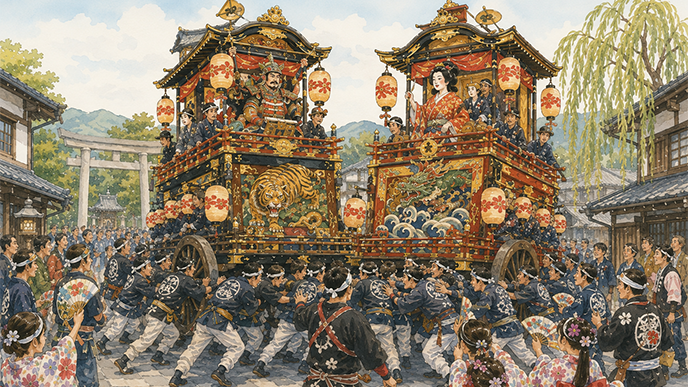
Kakunodate in Semboku City, Akita Prefecture is a castle town known as ``Little Kyoto'' where samurai residences from the Edo period still remain. Once a year, there are three days when this quiet town takes on a wilder look.
``Kakunodate Matsuri no Yama Gyouji''. This festival is known for ``Yamabutsuke,'' in which 18 giant Hikiyama floats parade through the town, and the mountains that meet on the road collide head-on. In 2026, it will be held from September 7th (Monday) to September 9th (Wednesday).
⛩️ Three days of two festivals, Shinmeisha and Yakushido
It is said that Kakunodate's mountain events began in the early Edo period, when the Satake Hokuke family came to rule Kakunodate. It has a history of about 350 years, and in 2016 it was registered as a UNESCO Intangible Cultural Heritage, ``Yama, Hoko, and Float Festivals''. It is also a nationally designated important intangible folk cultural property.
What makes this festival unique is that festivals at two shrines overlap during the festival. From September 7th to 8th is the annual festival of Kakunodate Sochinju Shinmeisha Shrine, and from September 8th to 9th is the festival of Mt. Katsuragi Jojuin Yakushido Hall, and both will be held simultaneously on the 8th of Chunichi. Each of the 18 districts called 18-cho-nai (cho-nai = town area) sends out a float, and on the first day the float goes to Shinmeisha Shrine, on the second day it goes to Yakushi-do after being visited by the head of the Satakekita family, and on the third day it goes around the town centering on Yakushi-do.
Hikiyama is about 5 meters high and weighs several tons. Samurai dolls and Kabuki dolls are displayed on the upper tier, and musicians playing ``Oyama Hayashi'' are inside. Dozens of people are involved in moving each float, including pullers, pushers, female dancers called tekomai, and ``wakamonogashira'' who act as negotiators.
Main schedule for 2026
The schedule is based on the official announcement of Semboku City. It may change depending on the weather.
| date | Main events |
|---|---|
| 9/7 (Monday) | 10:00~ Shinmeisha Annual Festival "Same Day Festival" / 16:00~ Shinmeisha Visit / 20:00~ Yoimiya Festival |
| 9/8 (Tue) | 8:00~Shinmeisha Shrine Mikoshi Passage/10:00~17:30 Satake Hokue Viewing and Oyama Hayashi Contest/15:00~ Yakushido Festival Opening Ceremony/18:00~ Sightseeing Yamabutsuke |
| 9/9 (Wed) | 7:10~ Yakushido Mikoshi parade/10:00~ Yakushido visit/10:00~ Hikiyama Hikimawashi |
💥 “Yamabutsuke” – a conflict that begins the moment negotiations break down
The biggest highlight of Kakunodate's mountain events is ``Yamabutsuke.'' When a Hikiyama and a Hikiyama meet in the narrow alleys of a castle town, ``negotiations'' begin where they discuss which one will give way. The rules for priority are complex, and the order of giving way is determined depending on the situation, such as those heading for worship, those heading for the Satake-Hokuie Kamiran, and the higher-ranking Hikiyamas in the Chonai area. However, when both parties are in a position where they cannot compromise, negotiations break down and a ``mountain attack'' occurs on the spot.
The clash begins with a signal from the young leaders, and several ton floats push each other head-on. The wheels creak, the timbers scream, and some floats sometimes topple over. Even so, the upper hayashi performers continue to play the ``Oyama Hayashi.'' These conflicts, which can last from minutes to hours, are not decided by a winner or loser, and only when both sides have exerted their efforts do they return to negotiations and reach a conclusion.
Yamabutsuke is not planned in advance, but happens by chance due to the timing and course of the Hikiyama. However, from 6:00 pm on September 8th there is a time period called ``Kanko Yama Buttsuke'', during which intentional clashes are held in the town center. From the 8th to the early morning hours of the 9th, when the boats are towed through the night, it's a time when normal negotiations are more likely to occur.
Viewing points
These are the key points to enjoy Kakunodate's mountain events.
- If you want to watch Yamabutsuke:The time and location of the ``Sightseeing Yamabutsuke'' event, which will be held from 6pm on September 8th, will be announced in advance, so you can be sure to see it. If you want to see an accidental collision that is closer to its original appearance, it is said to be a good idea to walk through the town center (the old town, about a 10-minute walk from Kakunodate Station) from late at night on the 8th to early morning on the 9th.
- Viewing of the Satake Kita family:From 10:00 a.m. on September 8 until the evening, a ``screening'' will be held at the former Ishiguro family residence, where the head of the Satakekita family will judge the workmanship of each float and Oyamahayashi. The sight of Hikiyama floats stopping in front of the gates of samurai residences and dedicating music is a scene where you can see and understand the origins of this festival.
- Stroll along Samurai Residence Street:Kakunodate is called ``Michinoku no Kyoto,'' and the city's inner town (Uchimachi = samurai residence street) and outer town (Tomachi = merchant town) remains as it was in the Edo period. If you walk along the Samurai Residence Street between festivals, you can experience the relationship between the path the Hikiyama floats take and the history of the samurai town. There are samurai residences that are open to the public, such as the Aoyagi family, the Ishiguro family, and the Iwahashi family.
- Safe viewing position:When hitting a mountain, several tons of hikiyama move. Please do not stand in front of the Hikiyama in the direction of travel or in the extension line of the pushing. Please follow the instructions of local security guards and youth leaders.
- stay:Accommodations in Kakunodate Town fill up early during the festival period. If you cannot make a reservation, you have the option of staying at Lake Tazawa (about 12 minutes by Akita Shinkansen from Kakunodate Station) or Omagari (about 20 minutes by Akita Shinkansen).
Access to Kakunodate
| Place of departure | route | Time required |
|---|---|---|
| Tokyo | Direct access to Kakunodate Station on the Akita Shinkansen "Komachi" | Approximately 3 hours 15 minutes |
| Akita | Take the Akita Shinkansen "Komachi" to Kakunodate Station | Approximately 45 minutes |
| Sendai | Tohoku Shinkansen → Omagari → Akita Shinkansen | Approximately 2 hours 30 minutes |
| Kakunodate Station | Walk to the old town | Approximately 10 minutes |
🏯 300 years of negotiations with the castle town of the Satake Kita family
Kakunodate was established in 1620 by Yoshikatsu Ashina of the Satake Kita family, and was developed into a castle town with clear divisions into inner and outer towns. A plaza called ``Hiyoke'' was established between the inner town where the samurai lived and the outer town where the merchants lived, and this town division remains almost unchanged today. Hikiyamas mainly pass through the alleys of Sotomachi, and negotiations occur mainly at Sotomachi intersections. The festival stage itself follows the design of the town in the Edo period.
The essence of this festival lies in the word "negotiation." When two Hikiyama floats meet on a narrow road, they always communicate verbally rather than simply pushing their way through. The rules of priority, the past relationships between the clans, the lineup of young leaders, the purpose of the parade that day - a variety of factors are taken into consideration before a conclusion is reached, and only when things break down does a conflict of force begin. For over 300 years, this negotiation etiquette has been accumulated as wisdom for continuing the festival in the same town. While the ferocity of the clashes tends to get the focus, the long negotiations that take place before that happen are at the heart of this festival.
After the festival ends on September 10th, the town of Kakunodate once again returns to being a quiet samurai residence town. Walking down the same alley where Hikiyama floats were crowded together just a few days ago, you will be amazed at the contrast between the two faces of this town. The three days of the festival and the other 362 days. The town of Kakunodate is made up of both.