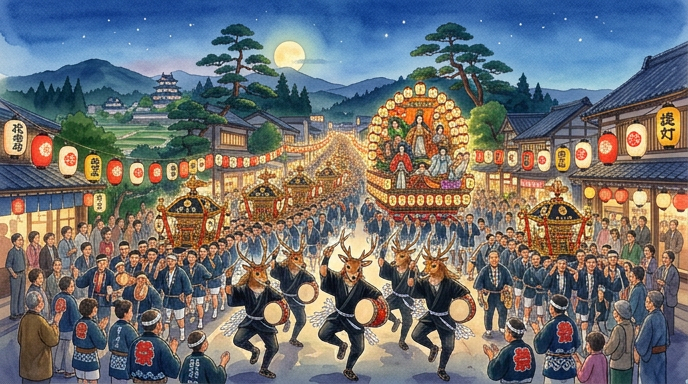
Hanamaki-shi, Iwate Prefecture, is known as the town where Kenji Miyazawa was born and raised, and where he wrote many poems and fairy tales. For three days in September, this town associated with Kenji is surrounded by a flood of light and sound during a festival.
"Hanamaki Matsuri". It is one of Tohoku's most representative fall festivals, with over 100 portable shrines, gorgeous floats, and the Shishiodori dance that has been passed down from the mountain villages of Tohoku all marching through town at the same time. In 2026, it will be held from Friday, September 11th to Sunday, September 13th, from 3:00 PM to 9:00 PM.
🏮 430 years of history and three main players
The origins of the Hanamaki Festival are said to date back to 1593 (Bunroku 2). It has a history of more than 430 years, dating back to a festival held by the townspeople to express their gratitude when Kitashosai, the first lord of Hanamaki Castle, developed the castle town. It was originally held as an annual festival at Toyagasaki Shrine, and the shrine is still the main shrine for the festival.
What makes this festival different from other festivals in Tohoku is that three elements with different characteristics take center stage at the same time. ``Furyu Dashi'' decorated with gorgeous carvings and lanterns, ``Mikoshi'' which is intimidating with over 100 floats, and ``Shika Odori'' which is a mountain village performing art. The sight of these three walking down the same street one after another is a sight that is hard to see at other festivals. Let's take a look at the origin and charm of each in turn.
Three pillars of Hanamaki Festival
| element | Features |
|---|---|
| Furyu Dashi | Dashi floats depict historical scenes and stories using dolls and decorations. Looks great at night with the light of lanterns. |
| Mikoshi | In 2015, a Guinness World Record was set for 114 simultaneous transfers. Approximately 100 units participate every year. |
| deer dance | A local performing art in which dancers with deer antlers on their heads and long bamboo leaves on their backs dance while playing drums. |
🦌 Deer Dance - Communication between mountains and people
Of the three pillars, the one that most symbolizes Hanamaki-ness is the "deer dance." The dancers wear wooden masks shaped like deer heads (shishigashira), and on their backs they hold thin bamboo pieces called sasara, which are over 3 meters long. The sight of them dancing in groups while beating the drums they hold in their bellies is as powerful as if a mountain beast had descended into the village. The basic form is to form a group of 8 or 12 animals.
The deer dance is said to have its origins as a memorial dance performed by hunters to appease the spirit of the deer they had killed. During the Edo period, it spread throughout the Tohoku region, centering on the former Sendai domain, and each region developed its own unique style. In Iwate Prefecture, which includes Hanamaki, there are taiko dance-related schools such as Gyozan-ryu and Kanatsu-ryu, each of which has been passed down in each village.
Kenji Miyazawa is known as a writer who deeply loved this deer dance. ``The Beginning of the Deer Dance,'' which was included in the first collection of children's stories published in 1924, ``The Restaurant of Many Orders,'' is a fantastic story in which a hunter hears the conversation of deer resting by a bonfire and witnesses the origin of the deer dance. ``Then, because of the glare of the curly clouds in the west, the setting sun turned red and poured onto the moss fields.'' This short fairy tale, which begins with this sentence, is said to be the one in which the climate and spirit of Tohoku are most vividly expressed among Kenji's works. If you read this before watching the deer dance at the Hanamaki Festival, you will see what Kenji sensed in the sound of the drums and the movement of the deer heads.
Viewing points
These are the key points to enjoy the Hanamaki Festival.
- venue:The main venue is the "Omatsuri Hiroba (Kamimachi)" in the center of Hanamaki City, and the main street of the festival that extends from there. About 20 minutes walk from JR Hanamaki Station or 5 minutes by taxi from the station. During the festival period, a shuttle bus will be operated between the station and the venue.
- Mikoshi parade:The simultaneous carrying of the mikoshi is usually held on Saturday evening in the middle of the day. The sight of around 100 mikoshi moving in a line is a scale that can only be seen at this festival. The 114 bases in 2015 is a world record, but the number of participating bases changes each year.
- Furyu Dashi Parade:The most beautiful time is after sunset (around 6pm) when the lanterns shine in. The doll decorations based on history and stories change every year in each town, and local people spend a year making them.
- Deer Dance/Kagura Gongenmai:A dedication performance will be held on a special stage in the festival plaza. The times vary depending on the day, so please check the time schedule on the Hanamaki Tourism Association official website for the day.
- Hanamaki Bayashi Dance:This is a dance parade held on the evening of the first day, with citizen participation. There are some ren that you can participate in without pre-registration, and there are times when tourists can just jump in and dance.
Walking through Kenji's Hanamaki
This is a spot connected to Kenji Miyazawa that you can stop by before or after the festival.
| facility | Content and access |
|---|---|
| Kenji Miyazawa Memorial Museum | A central facility that introduces Kenji's life and works. Manuscripts, favorite items, and photographs are on display. Approximately 5 minutes by taxi from Shin-Hanamaki Station. |
| Kenji Miyazawa Ihatovkan | Kenji research museum. Contains domestic and international research books and related works. About 5 minutes walk from the memorial hall. |
| Kenji Miyazawa Fairy Tale Village | An outdoor themed facility where you can experience worldviews such as "Night on the Galaxy Express." Area adjacent to the memorial hall. |
🌾 Autumn of “Ihatov”
Kenji called Hanamaki "Ihatov." This coined word, which sounds like Esperanto, is the name of the utopia that Kenji envisioned in his mind, and its original form was the countryside and mountains of Hanamaki. Hanamaki in September is the season when the rice ears turn golden yellow and the morning and evening air begins to clear. During the three days of the festival, the streets of Hanamaki are filled with lights and sounds, in contrast to the usual silence, but if you leave the center a little, you can still see the rice fields and mountains that Kenji walked through.
There is no direct causal relationship between the appearance of the deer dance at the Hanamaki Festival and Kenji's writing of ``The Beginning of the Deer Dance.'' However, the fact that the local performing arts that Kenji loved are still being performed in the same town more than 90 years after his death shows the continuity of this region's culture. If you listen to the festival drums and try to imagine what Kenji discovered in the sound, you will begin to see the depth of the town of Hanamaki in a slightly different light.
Hanamaki is about 3 hours from Tokyo on the Tohoku Shinkansen to Shin-Hanamaki Station, and about 45 minutes on the conventional line from Morioka Station. There are Hanamaki Onsen Villages (Hanamaki Onsen, Dai Onsen, Suzu Onsen, etc.) within the city, making it a perfect place for a 1-2 night stay that combines festivals and hot springs.