Kishiwada City, Osaka Prefecture. In this castle town facing Osaka Bay, on weekends in mid-September, the entire city begins to sway to a single rhythm.
``Kishiwada Danjiri Matsuri''. This festival is known nationwide for its ``yari mawashi,'' in which Danjiri, weighing approximately 4 tons, run through the streets at full speed with loud noises and dramatically change direction at intersections. The September festival in 2026 will be held at Yoimiya on Saturday, September 19th and at the main shrine on Sunday, September 20th.
🏯 1703年、五穀豊穣の稲荷祭から
The Kishiwada Danjiri Festival is said to have its origins in 1703 (Genroku 16). It is said that the festival began when Nagayasu Okabe, the lord of the Kishiwada domain at the time, invited Kyoto's Fushimi Inari to the Sannomaru within Kishiwada Castle and held an Inari festival to pray for a rich harvest. It is an autumn festival representing southern Osaka Prefecture, with a history of about 320 years.
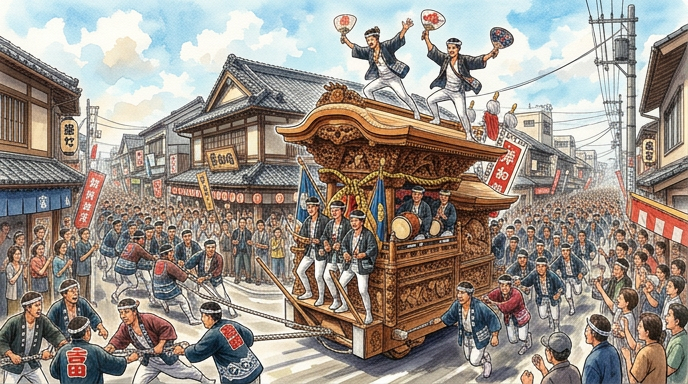
Danjiri is a type of Hikiyama that is made of zelkova wood and has intricate carvings all over its surface. Two people called ``daikugata'' ride on the roof and wave fans and fans on top of the speeding danjiri. Inside, drums, gongs, and flutes are played incessantly, and hundreds of pullers pull ropes in front and behind. The whole town is involved in moving one Danjiri.
There are two festivals in Kishiwada City: a September festival and an October festival. The September festival is a joint festival between the Kishiwada area (Kishiki Shrine, Kishiwada Tenjingu Shrine, Yasaka Shrine) and the Haruki area (Yasaka Shrine), with a total of 35 cars participating, 22 cars from the Kishiwada area and 13 cars from the Haruki area. The October festival is a separate festival held in the northern part of the city, such as the Yamate district and the Minami Kanmori district, and the participating towns and dates are different. This article deals with the September festival.
September 2026 festival schedule
The schedule is officially announced by Kishiwada City. Times may vary slightly by district.
| date | event | time |
|---|---|---|
| 9/13 (Sun) | Test pulling (1st time) | Around 14:00-16:00 |
| 9/18 (Fri) | Test pulling (2nd time) | Around 14:00-16:00 |
| 9/19 (Sat) | Yoimiya (Hikidashi, Shrine entry, etc.) | 6:00~22:00 |
| 9/20 (Sun) | Main shrine (entering the shrine, parade, towing lanterns) | 9:00~22:00 |
💨 「やりまわし」――全速力で直角に曲がる
The biggest highlight of the Kishiwada Danjiri Festival is the Yarimawashi. The art of making a 4-ton danjiri run at full speed while changing direction 90 degrees at an intersection - it sounds simple in words, but it's hard to understand when you see it in person. While floats at other festivals rotate slowly and change direction, Kishiwada's Danjiri do not slow down and turn at right angles against centrifugal force.
What makes this process possible is the cooperation of the people who play the roles of ``maeteko'' and ``ushiroteko.'' The front lever pulls a rope near the front wheels, and the rear lever controls the direction by operating the lever on the rear wheel. Approximately 500 to 1,000 pullers, noisemakers, carpenters, and levers--everyone in one town must work in unison for a moment to succeed. If they fail, the danjiri may overturn and the carpenter may fall off the roof.
The carpenter on the roof unfurls his fan, jumps, and continues to dance during this life-threatening moment. The moment the danjiri completes its turn at the intersection, the carpenters stand on the edge of the roof and spread their arms outstretched, a scene that is known as a symbol of this festival. Each town has its own style of carpenter dance, and the locals compare each year to see which town's carpenter dance is more beautiful.
Viewing points
These are the key points to enjoy the Kishiwada Danjiri Festival.
- Yarimawashi famous places:Particularly famous are the intersections of Kankanba (near the intersection of Kishiwada Ekimae Shopping Street) and Kokado Kaigen. The can-can area is wide and you can see multiple danjiri performing the dance in succession. Yoimiya's ``Hikidashi'' from 6 a.m. is the time when many Danjiri gather at this point.
- Special viewing seats:In recent years, paid viewing seats have been set up where you can watch the Yarimawashi up close. Advance reservations are required, and sales usually begin in June. This is the surest way to be seen safely.
- Towing with lanterns:At both Yoimiya and Main Shrine, a ``lantern pulling process'' is held from around 7:00 pm, in which about 200 lanterns are hung from danjiri. In contrast to the daytime rush, the train moves through the city at a leisurely pace, and the sounds of the music are calmer than in the daytime.
- Ensuring safety:Please do not stand on the Danjiri towing route or at intersections. There have been fatal accidents in the past. Please be sure to follow the security guard's instructions and restrictions.
- Test towing:Before the actual event, each town will conduct a test tug on September 13th and 18th. It is popular among local festival fans as it is a time when there are fewer spectators and you can watch the yari mawashi in a relatively calm manner.
Access to Kishiwada
| Place of departure | route | Time required |
|---|---|---|
| Namba (Osaka Minami) | Kishiwada Station on the Nankai Main Line/Express | Approximately 25 minutes |
| Kansai Airport | Kishiwada Station on the Nankai Main Line/Airport Express | Approximately 20 minutes |
| Kyoto | JR Kyoto Line → Osaka → Higashi Kishiwada Station on the Hanwa Line, or Kishiwada Station on the Nankai Main Line | Approximately 1 hour 30 minutes |
| To Haruki district | Haruki Station on the Nankai Main Line (near Namba, one of Kishiwada Station) | 2 minutes from Kishiwada Station |
🪚 彫刻の芸術品としてのだんじり
Kishiwada danjiri attract attention only when they are seen running, but when you see them up close when they are stationary, you will be amazed at the level of perfection as a craft. Three-dimensional carvings are applied to all surfaces, including the roof, pillars, balustrades on the large roof, and around the waist. The subjects are mainly famous scenes from history and military stories such as the Genpei War, Taiheiki, and Romance of the Three Kingdoms. It is said that it takes anywhere from several years to more than ten years to build a new Danjiri, and it sometimes costs more than 100 million yen.
Danjiri are made by craftsmen called ``carpenters'' and ``horimonoshi'' who carve the sculptures. There are families of Danjiri carpenters around Kishiwada that have been passed down for generations, and are closely related to the techniques of shrine carpenters. On days other than festival days, if the doors of the Danjirigoya in each town are open, you may be able to see the sculptures. If you walk through the town on the morning of Yoimiya before the parade, you can see the beautifully decorated Danjiri up close.
The Kishiwada Danjiri Festival is a festival where two opposing beauties coexist: the speed of running and the precision of carvings. Danjiri floats are always in motion somewhere in the city from 6 a.m. when they are pulled out to 10 p.m. at the main shrine. As you walk through the festival, which changes its appearance throughout the day, at different times, you will begin to see the depth of Kishiwada's heart. Three weeks after the September Festival ends, the October Festival will be held in the northern part of the city from October 10th to 11th, and autumn in Osaka deepens with the sound of Danjiri.