Peach Festival on March 3rd, Boy's Festival on May 5th, and Tanabata on July 7th are annual events in Japan that many people are familiar with. However, only a minority of Japanese people know about another festival that is supposed to be an extension of this, the Chouyou no Sekku on September 9th.
September 9th was once considered the most prestigious of the five seasonal festivals, but in modern times it is sometimes called the ``forgotten festival.'' We will introduce its origins and how you can enjoy it at home now.
🌼 9が重なる日――陰陽思想と菊の節句
The origin of the Chrysanthemum Festival lies in the ancient Chinese idea of yin and yang. Odd numbers were considered ``yang'' numbers, and even numbers were ``yin'' numbers, and it was thought that days when yang numbers overlapped had special power. September 9th, when the highest single-digit yang number ``9'' overlaps, was named ``Chūyō'' (the day when yang overlaps) because it is the day when the yang energy is at its peak.
Based on the idea that too much positive energy can lead to instability, a custom was born on this day to exorcise evil spirits and pray for longevity. In China, there was a custom of climbing to high ground, drinking chrysanthemum wine, and wearing shuyu (a kind of gummy fruit). Chrysanthemums are considered to be a symbol of longevity, and there is a legend that those who drank the dew from chrysanthemums lived hundreds of years.
This custom was introduced to Japan during the Heian period and became established as an event in the imperial court. The ``Chrysanthemum Viewing Banquet'' is held in the Shishinden, where the Emperor gives chrysanthemum wine to his courtiers and composes poetry. In the Edo period, the shogunate officially established the ``Gosekku,'' and Choyo became a national holiday, along with Jinbi (January 7th), Kamishi (March 3rd), Tango (May 5th), and Tanabata (July 7th). At the time, it was considered the most formal of the five seasonal festivals, with feudal lords visiting Edo Castle to offer prayers to the shogun.
Chrysanthemum in the five festivals
The five seasonal festivals established by the Shogunate during the Edo period all fall on odd-numbered days.
| date | Festival name | symbolic plant |
|---|---|---|
| January 7th | person-day | Nanakusa |
| March 3rd | Joshi/Peach Festival | 桃 |
| May 5th | Tango | Iris (shobu) |
| July 7th | Tanabata (Tanabata) | Bamboo/bamboo |
| September 9th | Choyo/Chrysanthemum Festival | 菊 |
🍶 平安貴族の「菊の被綿」
Kiku no Kisewata is a uniquely Japanese custom related to Chyoyo that was popular during the Heian period. The night before, cover the chrysanthemum flowers in the garden with cotton (mawata = silk) and leave it overnight to absorb the night dew and the scent of chrysanthemums. The next morning, if you wiped your face and body with the cotton, it was said that the medicinal properties of chrysanthemums would exorcise evil spirits and help you maintain your youth. This custom was especially loved by women in the Heian period.
Murasaki Shikibu's Diary depicts a scene in which Murasaki Shikibu was given a chrysanthemum cover as a gift from Fujiwara no Michinaga's wife, Minamoto Rinshi, and he responded with a song, saying, ``When I wear a young yukata, my sleeves flutter, and I pray for the dew of the flowers to be given to the young lord.'' This episode shows how important the belief that chrysanthemum dew brought rejuvenation was held in court culture.
In places such as Omiya Hachimangu Shrine in Kyoto, chrysanthemum decorations are still recreated around September 9th, and you can see the elegance of the Heian period.
How to enjoy at home
There are ways to easily spend Chrysanthemum Festival at home.
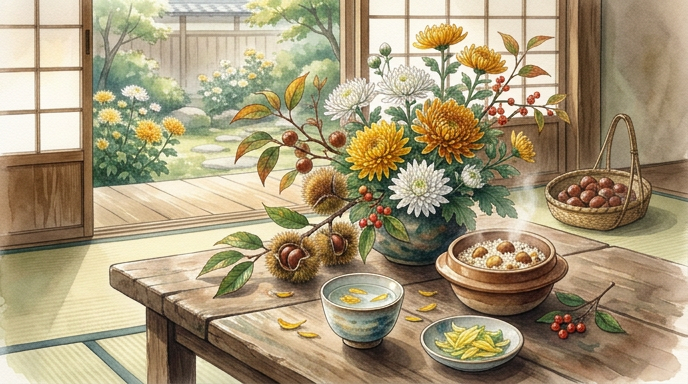
- Chrysanthemum wine:This is the simplest way to spend Chyoyo, simply by adding edible chrysanthemum petals to your sake. It doesn't matter whether it's cold sake or hot sake. You can purchase edible chrysanthemum petals (such as ``Mottenoho'' in Yamagata Prefecture) at supermarkets. The aroma of chrysanthemums transfers to the sake, allowing you to experience the same taste as the Heian nobility.
- Edible chrysanthemum dishes:Edible chrysanthemums are commonly used in Yamagata and Niigata prefectures. There are a variety of ways to use them in cooking, such as boiling the petals and making them into vinegar, making them into ohitashi, or sprinkling them on miso soup. In early September, you can often see them in the vegetable section of supermarkets.
- Chestnut rice:Chongyang is also called ``Chestnut Festival''. This is the season when new chestnuts start appearing on the market, and chestnut rice is the most homely way to enjoy Chongyang. Add about 10 to 20% chestnuts to the rice and cook with sake and a little salt.
- Decorate with chrysanthemums:Just by decorating your entryway or table with a single cut chrysanthemum, you can feel the sun. Flower shops have a wide variety of chrysanthemums on display in September. Although chrysanthemums are associated with Buddhist flowers, there are also many varieties that are easy to decorate, such as ring chrysanthemums, spray chrysanthemums, and ping pong chrysanthemums.
- Visit the Chrysanthemum Festival:Events related to chrysanthemums are held in various places from around the time of Chongyo to autumn, such as the Chrysanthemum Ceremony and Karasu Sumo at Kamigamo Shrine in Kyoto, the Chrysanthemum Festival at Yushima Tenmangu Shrine in Tokyo, and the Nihonmatsu Chrysanthemum Dolls in Nihonmatsu, Fukushima.
📅 なぜ「忘れられた節句」になったのか
There are several reasons why Chyo is the only one among the five festivals that has not been passed down to modern times. The biggest difference is the shift in the sense of season due to the adoption of the new calendar (Gregorian calendar) in 1873. September 9th according to the lunar calendar falls in mid-to-late October, which is the time when chrysanthemums are in full bloom. However, September 9th according to the new calendar is still in the late summer heat, when the chrysanthemums have just begun to bud. Even though it was the ``Chrysanthemum Festival,'' the chrysanthemums were not blooming -- this disconnection from the sense of season made the festival lose its sense of being an event.
Another reason is that Chongyang was difficult to connect with commerce. There are Hina dolls for the Peach Festival, May dolls and carp streamers for the Boys' Festival, bamboo decorations for Tanabata, and other seasonal decorations. Chrysanthemums, the main character of Chongyang, were grown in the garden at home and were not suitable for large-scale commercialization. As the festival became established in the lives of the common people, only Chongyang was left out of the cycle of commerce.
Still, this festival is as simple as drinking a cup of chrysanthemum wine, cooking chestnut rice, and decorating a single chrysanthemum flower, and you can experience the court rituals of over 1,000 years ago. Just by taking the time to smell the scent of chrysanthemums on the evening of September 9th, you can bring back the forgotten milestones of the season.