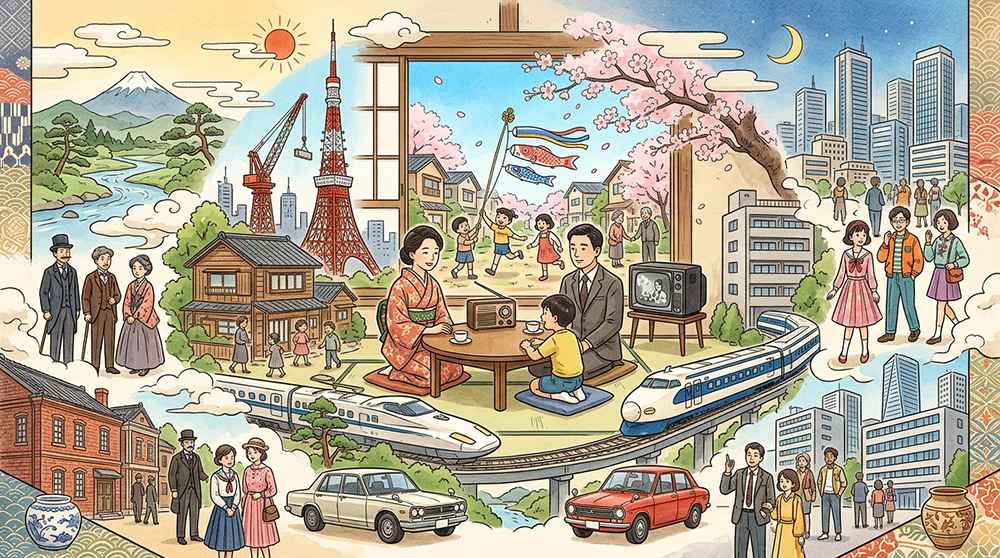
On April 29th, Japan will celebrate Golden Week, a national holiday that marks the beginning of a long holiday.
"Showa no Hi". This holiday, which originates from Emperor Showa's birthday, is deeply connected to the ``Gengo'' method of counting time, which Japan is the only country in the world that continues to use it continuously.
🗓️ Era name - “Another calendar” that remains only in Japan
The year 2025 in the Western calendar corresponds to ``Reiwa 7'' in Japan. In Japan, in parallel with the Western calendar (Gregorian calendar), a unique chronological system called ``gengo'' is officially used, which is changed with the enthronement of the emperor.
The origin of the era name system dates back to the Taika era in 645. Although this system was introduced from China, all countries that used era names, including China, Vietnam, and the Korean Peninsula, have abolished them, and Japan is the only country that continues to use era names as a national system.
The era names since modern times have been Meiji (1868-1912), Taisho (1912-1926), Showa (1926-1989), Heisei (1989-2019), and the current Reiwa (2019-).
Japanese people use the Western calendar and the era name differently in their daily lives, and the era name is written on driver's licenses and official documents, and expressions such as "born in the Showa era" and "raised in the Heisei era" are naturally used in conversations to express generations.
Key points to understand
These are points for understanding Showa Day and era name culture.
- The Showa era:Showa is the longest era name in modern Japanese history, lasting 64 years from 1926 to 1989. The turbulent history of war and defeat, recovery from the ashes, high economic growth, and bubble economy is condensed into one era name.
Showa Day is said to be a day to "reflect on the Showa era, which achieved recovery after turbulent times, and think about the future of the country." - History of holiday names:April 29th was Emperor Showa's birthday during his reign. After Emperor Showa passed away in 1989, the name was changed to "Greenery Day," and in 2007 it was renamed to the current "Showa Day." It is unusual among Japanese holidays for one date to change its name three times.
- How to decide the era name:The new era name is selected by the government upon the accession of the Emperor. The word ``Reiwa'' in 2019 is taken from the preface to the song of plum blossoms in Japan's oldest poetry collection, Manyoshu.
It was customary to quote from Chinese classics, but Reiwa was the first time that a Japanese classic was used, and it caused a big stir when it was announced. - The beginning of Golden Week:Showa Day is the first day of Golden Week (GW), Japan's largest long holiday. Public holidays continue from Showa Day on April 29th to Constitution Day on May 3rd, Greenery Day on May 4th, and Children's Day on May 5th, and if you take paid days off on weekdays in between, you can end up with up to 10 consecutive holidays.
At this time of year, Shinkansen trains and airports are crowded with people returning from their hometowns and tourists, and highways are jammed for tens of kilometers.
🏯 “The atmosphere of the times” carved by the era name
For Japanese people, the era name is not just a way to count the year, but also a word that expresses the atmosphere and values of the era itself. ``Showa'' refers to grit and humanity, ``Heisei'' refers to the Internet and natural disasters, and ``Reiwa'' refers to diversity and new lifestyles. Japanese people associate a common sense of the times with each era name.
If you visit Japan around April 29th, you can experience the bustle of Golden Week firsthand. Congested Shinkansen trains, traffic information on expressways, crowds at tourist spots - these are experiences of Japanese holiday culture in themselves. Also, if you have a chance to see documents from government offices or banks while you are in Japan, you may notice that "Reiwa Year" is printed on them. Another time axis, different from the Western calendar, has naturally blended into every corner of society. Showa Day is a holiday that provides an opportunity to experience Japan's unique sense of time.