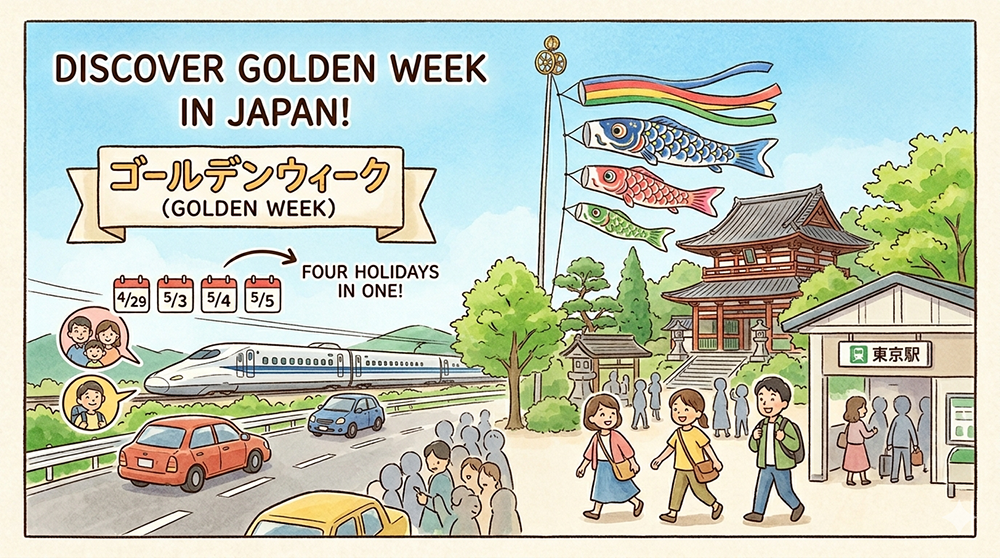
Every year from the end of April to the beginning of May, Japan enters a long holiday called Golden Week (GW).
Showa Day on April 29th, Constitution Day on May 3rd, Greenery Day on May 4th, and Children's Day on May 5th are consecutive holidays, and if you take paid vacation on the weekdays in between, you can get up to 10 consecutive holidays. During this period, the Shinkansen occupancy rate exceeds 180%, highways are jammed for more than 50km, and international flights at major airports remain full.
✈️ 映画業界が名付けた「黄金週間」
The name Golden Week took root in the 1950s. There are various theories about its origin, but the most widely known one is the movie industry theory. It is said that in 1951, the director of Daiei (a film company at the time) named the period Golden Week with the meaning of ``the best week'' because movies released during this period had box office results that exceeded New Year's and Obon.
NHK (Japan's public broadcaster) continues to use the expression ``Long Holidays'' instead of ``Golden Week'' due to its policy of avoiding expressions that would lead to advertising for a specific industry.
Key points to understand
These are the key points to understand Golden Week.
- Composition of holidays:Golden Week is not a single holiday, but a collection of four holidays. Showa Day (April 29th) (Emperor Showa's birthday), May 3rd (Constitution Day) (the day the Japanese Constitution came into force in 1947), May 4th (Greenery Day) (a day to get close to nature), and May 5th (Children's Day) (Boys' Day). The long holidays were born because holidays with different origins happened to be close to each other.
- “Calendar” and “long holidays”:Japanese companies are divided into those that follow the calendar, which only closes on public holidays, and those that close all holidays, including weekdays. The manufacturing industry often closes all at once due to factory efficiency, and the service industry is actually in a busy period. Even though you're in the same country, the way you spend your Golden Week is completely different depending on your industry.
- Crowds and prices:During Golden Week, it is not uncommon for accommodation rates in Japan to be 1.5 to 3 times the normal rate. Reserved seats on the Shinkansen may be sold out on the release date a month in advance. For tourists visiting Japan, this is a time when they need to be careful about both the crowding of tourist spots and rising prices. On the other hand, the number of people in the city center will actually decrease, and Tokyo's commuter trains will become empty.
- GW scenery:At this time of year, rice fields in the region are being prepared for rice planting, and the ``water mirror'' scenery of the sky reflected in the rice fields filled with water spreads throughout the region. In urban areas, carp streamers (decorations commemorating Children's Day on May 5th) flutter in parks and between buildings, and department stores and shopping malls begin Golden Week sales.
🌤️ 五月晴れ――一年で最も過ごしやすい季節
There is a word that describes the sky in Japan around Golden Week: ``Satsukinare''. Although it is now widely used to mean ``sunny weather in May,'' it originally referred to the brief spell of sunshine that appears during the rainy season, which is May in the lunar calendar. May in the new calendar marks the beginning of the rainy season, and is actually a season when the weather often continues to be sunny. The temperature is around 20-25 degrees Celsius, and the humidity is still low, making it one of the most comfortable times of the year to spend time outdoors. If you are prepared for crowds and price hikes, this is the best season to visit Japan based on the weather alone.
😔 連休明けの「五月病」
Golden Week is also accompanied by another social phenomenon unique to Japan. It is "Gogatsubyou".
In Japan, the new fiscal year begins in April. New employees start work, new students start school, and many people spend April filled with stress and fatigue from the new environment. Then comes the long holiday of Golden Week. The tension that had been holding me back suddenly loosens, and around mid-May, after the holidays, I start to feel lethargic and fatigued. This is May disease.
It is not an official medical term, but a colloquial term widely used in Japanese society. It is said to occur not only in new employees, but also in people whose environment has changed due to transfer or transfer, and every May, special features on May disease are featured on TV and in magazines. The fact that ``reaction after working too hard'' has a name as a social phenomenon is a phenomenon unique to Japan, resulting from the combination of Japan's fiscal year system that starts in April and the long holiday called Golden Week.