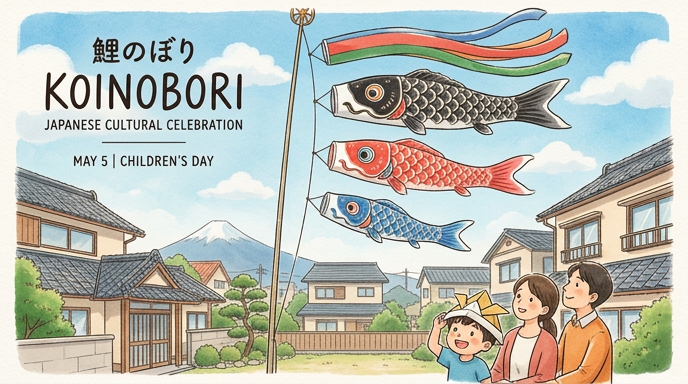
In May, carp-shaped windsocks that swim in the wind appear in residential areas and valleys between buildings in Japan.
It is "Koinobori". Children's Day, celebrated on May 5th, was originally an annual event called Tango No Sekku, which celebrated the growth of boys. Carp streamers, May dolls, helmet decorations, and iris baths. The customs associated with this day each have different origins and meanings.
🎏 Why koi fish swim in the sky
The origin of carp streamers lies in the Chinese story "Toryumon". The carp has been considered a symbol of success in life, as it is said to have become a dragon after climbing up the rapids called Longmen in the upper reaches of the Yellow River. During the Edo period, samurai families used to put up banners with their family crests on them during Boy's Festival, but it is said that carp streamers began when townspeople, who were not samurai, hoisted flags in the shape of carp.
A typical carp streamer has a five-colored streamer at the top, followed by a black carp (father), a red scarlet carp (mother), and a blue child carp (children). Some families add more carp depending on the number of children they have. In the past, it was common to set up tall poles in the garden and fly carp streamers, but with the increase in the number of people living in apartments, small carp streamers for balconies and indoor decorations are also becoming more popular.
Key points to understand
Here are some points regarding the customs of Boy's Festival.
- May doll and helmet decoration:The room is decorated with May dolls and helmet decorations. The decorations are modeled after the helmets and armor of military commanders, and represent the parents' wishes for children to grow up strong and strong. Items modeled after the helmets of famous military commanders are popular, with Date Masamune's crescent moon placket and Uesugi Kenshin's Iizuna Gongen placket being standard. Purchase prices range from tens of thousands of yen to hundreds of thousands of yen.
- Iris bath (shobuyu):There is a custom of taking a bath with irises floating on the night of May 5th. The strong scent of irises is said to ward off evil spirits, and because ``iris'' has the same sound as ``shōmu'' (respecting military), it was associated with the Boy's Festival. During this period, some public baths and super public baths also offer iris baths.
- Kashiwa mochi and chimaki:Kashiwamochi and chimaki are Japanese sweets eaten during Boy's Festival. Oak leaves are said to be a lucky charm that will ensure that the family lineage continues, as the old leaves do not fall off until new buds grow. People in the Kanto region tend to eat Kashiwamochi, and people in the Kansai region tend to eat Chimaki.
- Differences from “Children’s Day”:Boy's Day was originally an event for boys, but when Children's Day was established as a national holiday in 1948, it was defined as a day to "respect children's personalities, measure their happiness, and express gratitude to their mothers." Although it is considered a day to celebrate the growth of children of both genders, the actual customs are mainly related to events for boys, such as carp streamers and May dolls.
🎏 Carp streamer photography spot
Around Golden Week, events are held all over Japan where hundreds to thousands of carp streamers are made to swim all at once across rivers and valleys. Known locations include Tsuruuda River in Tatebayashi City, Gunma Prefecture (approximately 5,000 carp), Tsuetate Onsen in Kumamoto Prefecture (approximately 3,500), and Daigaku-dori in Kunitachi City, Tokyo.This is a photo spot that can only be seen at this time of year, where you can see a large number of carp streamers swimming all at once in the wind.
If you are traveling in Japan in May, you will have the chance to see carp streamers in gardens and parks in residential areas. It is a seasonal landmark from spring to early summer that can be found anywhere in Japan.