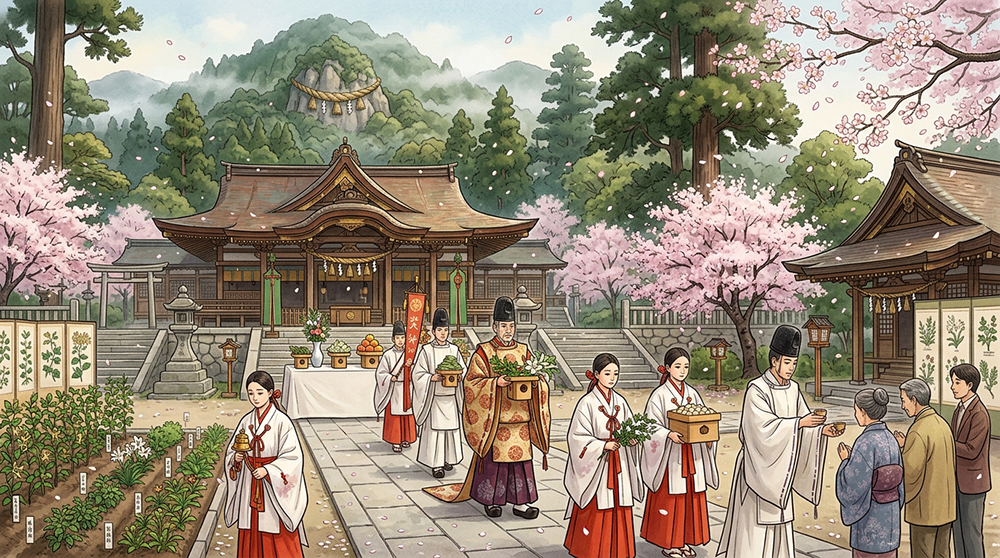
April is when the cherry blossoms are in full bloom and the petals begin to dance in the wind. Modern Japanese people despise this sight, but ancient people had different feelings about ``falling flowers.''
When the flowers fall, the god of plague takes advantage of it and spreads. The ritual born from this belief is the Hanashizume no Matsuri. And in Kyoto, there is the Yasurai Matsuri, which carries on the same faith in a different form.
🌺 花を鎮め、疫を封じる――鎮花祭
The origin of the Chinka Festival dates back to ancient times, and regulations were written down as an official national ritual in the Taiho Ritsuryo code, which was enacted in 701. The Ritsuryo Code stipulated that the festival be held at Omiwa Shrine and its subsidiary shrine, Saijinja, in Sakurai City, Nara Prefecture.
This ritual is based on the ancient belief that ``the gods of plague will scatter as the flowers fall,'' and the festival prays to prevent the spread of disease by placating the spirits of the flowers. It is one of the oldest public festivals to ward off epidemics in Japan, having been held for over 1,300 years.
Currently, the Chinka Festival is held not only at Omiwa Shrine and Sai Shrine, but also at shrines all over the country. We will introduce two representative companies.
Omiwa Shrine/Sai Shrine (Sakurai City, Nara Prefecture) -- April 18th
It is the origin of the Chinka Festival based on the Ritsuryo Code. Omiwa Shrine is said to be one of the oldest shrines in Japan, and does not have a main shrine, with Mt. Miwa itself as its object of worship. Sai Shrine, a set shrine, has been worshiped as the ``god of medicine'' since ancient times, and there is a medicinal herb garden within the grounds. At the Chinka Festival, medicinal herbs such as Suikazura and lily root are offered to prevent epidemics, and at the same time, gratitude and prayers are offered for their medicinal properties. After the ritual, participants are sometimes given medicinal wine or lily root.
The water that springs from the ``Medicine Well'' in the grounds of Sai Shrine is said to be effective against all illnesses, and worshipers can take it home with them.
Mizutani Shrine (Nara City, Nara Prefecture, Kasuga Taisha Setsusha) - April 5th
The Chinka Festival is also held at Mizuya Shrine, a shrine located along the Mizutani River on the north side of Kasuga Taisha. Mizutani Shrine is a shrine that enshrines the three pillars of Susano-no-Mikoto, Onamuchi-no-Mikoto, and Kushinada-hime, and has been a shrine that has been believed to heal illnesses and ward off epidemics since the Heian period.
At the Chinka Festival, prayers to quell the epidemic are sung in the morning, and a shrine maiden performs kagura. In the afternoon, a Kyogen performance by the Kasuga Taisha Negiza Kyogen Society will be performed, creating a unique structure that combines solemn rituals and performing arts.
Mizutani Shrine is an old shrine that also appears in the ``Chojo Shujincho'' written in 1133 in the late Heian period, and is said to be second only to the main shrine of Kasuga Taisha and Wakamiya Shrine.
Points of appreciation
These are the key points to understand the Chinhua Festival.
- Ancient association of flowers and pestilence:It may seem strange to a modern perspective, but early spring, when the cherry blossoms fall, marks a turning point in the climate, and in ancient Japan, it was actually a time when epidemics were more likely to occur. The ancient people's observation of the relationship between the falling of flowers and the spread of disease is a form of pre-scientific understanding of nature.
- Connection between medicine and faith:The Chinka Festival has long been associated with medicine, as medicinal herbs are offered at the Chinka Festival at Omiwa Shrine and Saijin Shrine. It is a ritual that combines faith and practicality, ``calming down'' an epidemic with the power of the gods, and ``actually curing'' it with medicinal herbs and liquor.
- Chinhua Festival in various places:In addition to Omiwa Shrine and Mizutani Shrine, the Chinka Festival is held at shrines across the country, including Isonokami Shrine in Tenri City, Nara Prefecture. Although the schedule and content vary from shrine to shrine, the basic purpose is to ``calm down epidemics during the flower season''.
👹 鬼が踊り、花傘が疫神を吸い寄せる――京都・やすらい祭
There is also a festival in Kyoto based on the same belief that ``falling flowers = plague.'' The Yasurai Festival is held on the second Sunday of April every year around Imamiya Shrine in Kita Ward, Kyoto City. It is considered one of Kyoto's three most unique festivals, and has been designated as a national important intangible folk cultural property.
Dancers dressed as red-haired and black-haired demons parade through the town, dancing vigorously to musical accompaniment. At the center of the procession is a large flower umbrella decorated with fresh flowers. It is a festival whose purpose is to trap the evil spirit that scatters on falling flowers by drawing it into this flower umbrella.
It is said that if roadside spectators step under the flower umbrella, they will be guaranteed good health for the year, and during festivals, a unique sight of people gathering under the umbrella is created.
Points of appreciation
These are the key points to enjoy the Yasurai Festival.
- Demon dance:The sight of the red-haired and black-haired demons jumping and dancing to the music of drums and gongs is impressive. This demon is interpreted to represent the god of plague itself, or to be an entity that drives away the god of plague.
- Imamiya Shrine and “Aburimochi”:In front of the gates of Imamiya Shrine, there are two aburimochi shops facing each other that are said to have been in business for over a thousand years. It is a small rice cake sprinkled with soybean flour, skewered on a bamboo skewer, grilled over charcoal, and topped with white miso sauce.It is a specialty that many people enjoy while worshiping during the Yasurai Festival.
- Similarities and differences with Zhenkasai:While Nara's Chinka Festival is a solemn ritual performed by Shinto priests, Kyoto's Yasurai Festival is a lively festival with public participation, including demon dances and parades of flower umbrellas. This is a good example of how the same belief that ``when flowers fall, plague spreads'' developed in different forms depending on the place and time.
🌸 奈良と京都で「花鎮め」を巡る
Behind the scenes of admiring the cherry blossoms, there was a fear of the flowers falling. The Chinka Festival and the Yasurai Festival are spring rituals that combine the complex feelings of Japanese people toward cherry blossoms: attachment to their beauty and reverence for the power of nature.
If you're visiting Nara or Kyoto in April, an interesting way to spend your time would be to add a ritual to pacify flowers to your itinerary. Mizutani Shrine's Chinka Festival (April 5th) is held on the grounds of Kasuga Taisha Shrine, and can be visited in conjunction with a stroll through Nara Park. The Chinka Festival (April 18th) at Omiwa Shrine is located in Sakurai City, about an hour by train from Osaka or Kyoto, and you can witness the ritual in the quiet grounds at the foot of Mt. Miwa. Imamiya Shrine, which holds the Yasurai Festival (second Sunday in April), is located in Kita Ward, Kyoto City, and is close to Kinkakuji Temple and Daitokuji Temple. Aburimochi in front of the gate can be enjoyed even on days other than festival days. While touring Nara and Kyoto during the cherry blossom viewing season, you will be exposed to the ancient prayer of ``calming down the falling cherry blossoms'' - you will discover another depth to these two ancient capitals as tourist destinations.