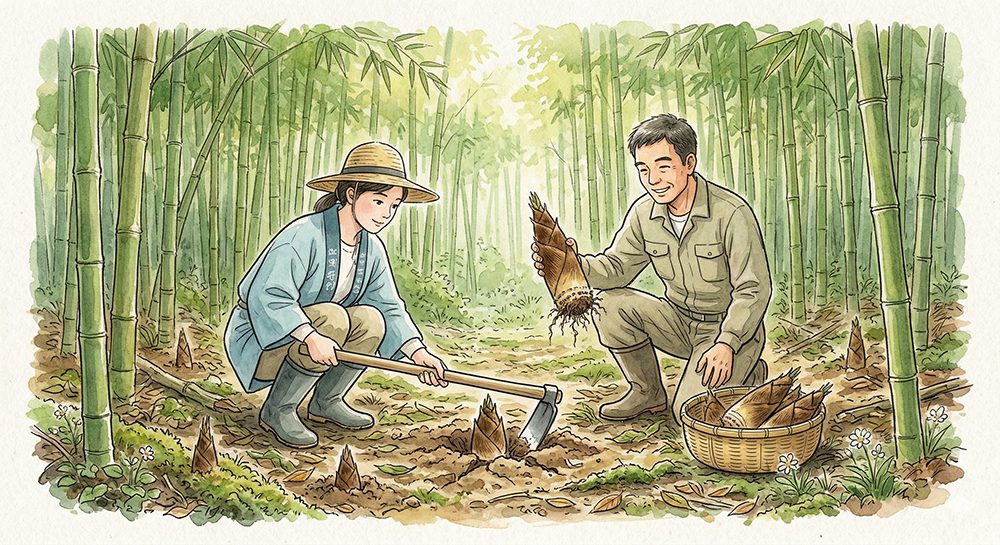
In April, bamboo shoots begin to appear in bamboo forests across Japan, pushing up slightly from the ground.
``Takenoko Gari'' is a spring experience where you dig up bamboo shoots from the ground using a special hoe. In Europe and America, bamboo shoots are commonly boiled in cans or bottles, but in Japan, freshly dug bamboo shoots are sometimes eaten as sashimi. Dig the ingredients out from under the ground with your own hands and enjoy them the same day. In spring in Japan, there are many such ``hunting, gathering, and eating'' experiences.
🎋 竹林に入り、地面を「読む」
Bamboo shoots are young shoots that grow from underground rhizomes of bamboo. It grows extremely quickly and turns into hard bamboo within 10 days after it emerges from the ground, so it is necessary to dig it up to find out whether it is still buried in the ground or just as soon as its head is just poking above the ground.
When picking bamboo shoots, we rely on slight bumps and cracks in the ground to locate bamboo shoots. Some people are experts at feeling the bulge in the ground with the soles of their feet.
Once you find it, carefully scrape out the soil around the bamboo shoots, insert a hoe into the roots, and separate them. It can take a few minutes even for an experienced person to dig out a single piece, but it can take more than 10 minutes for a beginner, making it a more physically demanding task than it appears.
Among Japan's famous bamboo shoot production areas, Shirako Takenoko from Nagaokakyo City in Kyoto Prefecture is particularly well known. Bamboo shoots grown in red clay soil are fair-skinned and have little astringency, and are said to have a delicate flavor that can be eaten as sashimi, and can be sold for several thousand yen each at restaurants.
Points of experience
Here are some points about bamboo shoot hunting and the food culture of raw bamboo shoots.
- Value of “morning digging”:The moment bamboo shoots are dug up, they begin to become astringent (acidity caused by oxalic acid and homogentisic acid). For this reason, special value is placed on ``morning bamboo shoots'' in Japan.
If you dig it first thing in the morning, boil it immediately, or if it's extremely fresh, cut it into thin pieces as sashimi and eat it with wasabi and soy sauce. This ``taste that can only be eaten freshly dug'' is what makes the bamboo shoot experience possible. - How to cook bamboo shoots:Japanese bamboo shoot dishes are diverse. The basic preparation is boiling it with rice bran to remove the scum, and from there it can be used to brighten up spring menus such as wakatake ni (stew with wakame), bamboo shoot rice, tempura, and Japanese bud dressing.
It is also used in stir-fries like in Chinese cuisine, but in Japan, the mainstream cooking method is to cook it in dashi stock or to make the most of the flavor of the ingredients. - Tourist farm experience:There are tourist farms mainly in the Kanto and Kansai regions that offer bamboo shoot digging experiences only in the spring. Many places will lend you boots and hoes, and you can usually take home the bamboo shoots you dig.
Some farms even allow you to boil and eat them on the spot.
🌿 春の「狩って食べる」文化
In spring in Japan, there are many experiences other than picking bamboo shoots where you can "pick and eat them yourself."
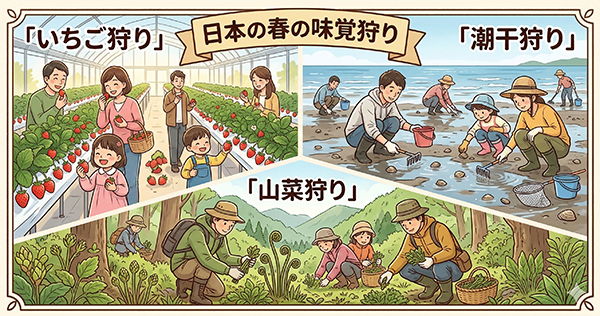
Clam picking (Shiohigari)is an experience where you can collect clams and other shellfish, which is held from April to May when the spring tides spread the tidal flats. Famous spots include Kisarazu City in Chiba Prefecture on the Tokyo Bay coast and Mikawa Bay coast in Aichi Prefecture, and the sight of families crouching down on tidal flats, scratching the sand with rakes in search of shellfish is a typical springtime feature in Japan.
The clams that are harvested are usually eaten on the same day as miso soup or steamed with sake.
Picking wild vegetables (Sansai Dori)This is an experience unique to spring in Japan. Edible wild plants that grow naturally in the mountains and fields of Japan, such as bracken, zenmai, kogomi, cod sprouts, and fukinotou, are collectively called ``edible wild plants.'' When made into tempura, wild vegetables lose their bitterness and are prized as a spring flavor.
In early spring, supermarkets set up wild vegetable corners, but many places also offer guided tours of Satoyama where you can pick your own wild vegetables. However, some wild plants are difficult to distinguish from poisonous plants, so it is best to go with an experienced guide or guide.
Strawberry picking (Ichigo Gari)is an experience where you can pick and eat all-you-can-eat ripe strawberries yourself in a plastic greenhouse, and you can enjoy it from January to May. There are also farms where you can taste and compare different varieties of strawberries, such as ``Tochiotome,'' ``Amaou,'' and ``Benihoppe.'' Foreign travelers are often surprised by the variety of Japanese strawberries and their high sugar content.
Points of experience
This is a common point when hunting for spring tastes.
- Awareness of “season”:In Japan, the concept of "season" is at the core of food culture. The term refers to the time when ingredients are at their most delicious.Bamboo shoots are in season in April, clams are in spring during the spring tides, and wild vegetables are in season for a few weeks after the snow melts.The season for each ingredient is short and limited.
This feeling of ``I can only eat this now'' drives Japanese people to hunt for spring flavors. - The word "hunt":In Japanese, the act of picking fruits and shellfish is expressed as "○○ hunting." An interesting feature of the Japanese language is that the word ``kari,'' which originally meant hunting, such as strawberry picking, grape picking, and clam picking, is widely used to refer to any experience of gathering food in nature.
- Confirm reservation and timing:Bamboo picking and clam picking are subject to the weather and tides, so advance reservations and confirmation of event status are required. Strawberry picking at tourist farms may end as soon as there are no more fully ripened berries.
🍽️ 「旬」を自分の手で収穫する
In an age where you can get ingredients at any time by going to the supermarket, you dare to dig, pick, and forage with your own hands. Japan's spring taste hunting is an experiential food culture born out of the Japanese people's obsession with ``seasonality,'' which allows them to feel the changing seasons with their tongues and bodies.
There are many spots where you can experience bamboo shoot digging and clam collecting within a day trip from the city center. The experience of going into a bamboo forest and digging up bamboo shoots while feeling the soil, or going barefoot on a tidal flat and searching for shellfish is an entrance to Japanese food that is completely different from eating at a restaurant. If you're visiting Japan in spring, it's an interesting way to spend half a day between sightseeing spots and experience the Japanese sense of ``following the seasons.''