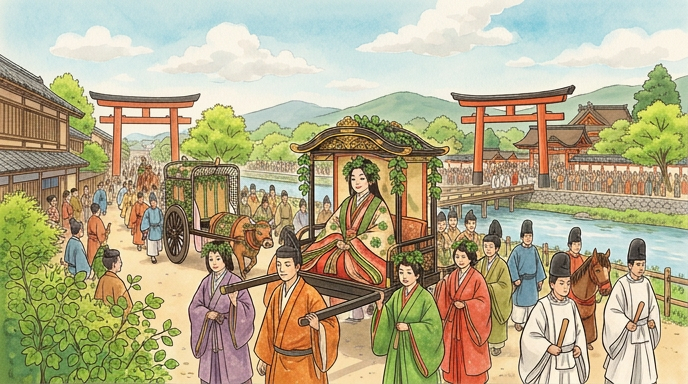
On May 15th, a procession of about 500 people wearing Heian period costumes walks down Miyakooji Street from the Kyoto Imperial Palace to Shimogamo Shrine and then Kamigamo Shrine.
"Aoi Matsuri". The official name is "Kamo Festival". It is one of the three major festivals in Kyoto, along with the Gion Festival and the Jidai Festival, and its origins date back approximately 1,500 years.
👘 A time when “matsuri” meant Aoi Festival
The origin of the Aoi Festival is said to date back to the fifth year of Emperor Kinmei's reign (544). It is said that this festival began when a festival was held in which a horse was raced in order to bring down the curse of Kamo Okami during times of poor harvests, famine, and the spread of disease.
It is an annual festival of both Shimogamo Shrine and Kamigamo Shrine, and is a ``Chokusai'' festival attended by the Emperor's messengers. During the Heian period, it was the most important festival rooted in aristocratic society, so much so that the word ``matsuri'' referred to the Kamo Festival. The Aoi Festival scene is also depicted in ``The Tale of Genji'', and the ``car fight'' stage where Aoi no Ue and Rokujo no Miyasudokoro fight over the place in the oxcart is famous.
The ``hollyhock'' in the festival's name comes from the futaba hollyhock and katsura leaf decorations worn by all participants in the procession. Hollyhocks are decorated with oxcarts, cows, and the crowns of imperial envoys.
Points of appreciation
This is the point to see the Aoi Festival.
- Road ceremony (procession):The highlight of the Aoi Festival is the procession called ``Roto no Gi.'' Approximately 500 people dressed in Heian costumes, 40 horses, 4 cows, 2 ox carts, and 1 palanquin depart from the Kyoto Imperial Palace at around 10:30am and head to Kamigamo Shrine via Shimogamo Shrine. The procession is approximately 8km long and takes approximately 5 hours to complete, with breaks along the way. In case of rain, it will be postponed to the next day.
- Saiodai:At the center of the procession is a woman called ``Saiodai.'' This role replaces the unmarried princess ``Saio'' who once served Kamo Shrine, and is chosen every year from among unmarried women connected to Kyoto. The figure of the Saio dai, wearing a heavy costume resembling the 12 simpletons and riding on a palanquin, attracts the most attention during the procession.
- Viewing spot:Paid seating will be available inside the Kyoto Imperial Palace and on the approach to Shimogamo Shrine. If you wish to view it for free, you can do so from the sidewalk along the procession route. The starting point of the Kyoto Imperial Palace, the Tadasunomori approach to Shimogamo Shrine, and the vicinity of Kitaoji Bridge are considered to be relatively easy to see. Paid seats are pre-sold and go on sale from early April every year.
- Pre-ceremony events:Prior to the roadside ceremony on May 15th, many pre-rites are held, including the Yabusame Shinto ritual at Shimogamo Shrine on May 3rd, the Saio Dai Misogi no Gi on May 4th, the Kamokura Beuma at Kamigamo Shrine on May 5th, and the Mikage Festival at Shimogamo Shrine on May 12th. If you are in Kyoto during Golden Week, you can also follow the Aoi Festival from these pre-gi festivals.
🐂 The Heian period is coming
Of the three major festivals in Kyoto, the Gion Festival features a procession of floats, and the Jidai Festival features a procession of costumes from each era, but the Aoi Festival's procession focuses on only one item from the Heian period. There are no armor or warrior processions, only Heian aristocrat costumes and ox carts. As a result, there is a unique tranquility that makes you feel as if the court culture of 1,500 years ago is passing right before your eyes.
The procession route is approximately 2 km from Kyoto Imperial Palace to Shimogamo Shrine, and approximately 6 km from Shimogamo Shrine to Kamigamo Shrine. It takes a lot of stamina to follow the whole process, but if you wait for the line at Tadasu no Mori at Shimogamo Shrine and watch the shrine ceremony at the shrine grounds upon arrival, you can enjoy it in about half a day. If May 15th is sunny, it will be a day to see the Heian period procession in the fresh greenery of Kyoto.