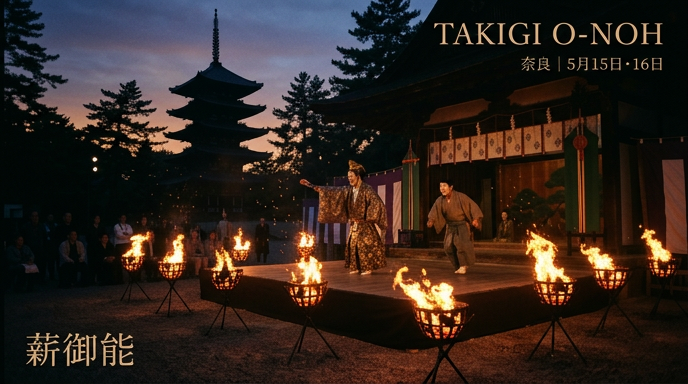
At dusk in May, bonfires are lit in the precincts of Kasuga Taisha Shrine and Kofukuji Temple in Nara, and Noh and Kyogen performances are performed in the flickering flames.
Takigi O-Noh is a Noh performance performed outdoors over a bonfire, and Nara's Takigi O-Noh is one of the oldest forms of outdoor Noh in Japan. In 2026, it will be held on May 15th (Friday) and 16th (Saturday).
🔥 The tradition of fire and Noh since 869
The origin of Nara's Takigi Noh is said to date back to the ``Takigi Sarugaku'' performed at Kofukuji Temple in 869 (11th year of Jokan). Sarugaku is a performing art that is the predecessor of Noh, and is said to have begun when it was dedicated at the Shunie festival at Kofukuji Temple. Since then, Nohgaku performances have continued at Kasuga Taisha Shrine and Kofukuji Temple for over 1,100 years.
The current Takigi Ono is performed over two days. The first day, the 15th, begins with the ``Noronji Bashiri no Gi'' on the Wakamiya Shrine stage of Kasuga Taisha Shrine, followed by Noh and Kyogen performances. On the 16th, performances by the five Noh schools (Kanze, Hosho, Konparu, Kongo, and Kita) and the second Kyogen schools (Okura and Izumi) will be held on a special stage in the Nandai Monzeki area of Kofukuji Temple.
Noh, which is performed on an outdoor stage with only the flames of a bonfire as lighting, has a completely different atmosphere than Noh seen indoors in a Noh theater. Every time the sparks fly up and the flames sway, the expression on the Noh mask appears to change. As the sun sets, the surroundings darken, and only the bonfire and stage stand out. Including these changes, it is an experience unique to outdoor Noh.
Points of appreciation
This is the point to see Takigi Gonoh.
- Venue and dates:It will be held on the 15th at Kasuga Taisha Shrine (stage in front of Wakamiya Shrine) and on the 16th at Kofukuji Temple (special stage in front of Nandai Monzeki). All of these places are components of World Heritage Sites. Kasuga Taisha Shrine and Kofukuji Temple are about a 10-minute walk away, and are located in the Nara Park area.
- Viewing:There are paid sponsor seats and a free standing area for the Takigi Noh performance at Kofukuji Temple. Sponsored seats are sold out in advance and are often sold out after sales start, so early confirmation is required. Although you can see the stage from the free area, the distance makes it difficult to see the facial expressions on the Noh masks.
- If you are seeing Noh for the first time:Because the lines in Noh are spoken in archaic languages, they can be difficult to understand even for Japanese people. If you look up the synopsis of the performance in advance, it will be easier to follow the meaning of the dance even if you don't understand the words. Compared to Noh, Kyogen has more movement and has elements of comedy, so if you are experiencing Noh for the first time, Kyogen may be easier to get into.
- Temperature and clothing:Nara in mid-May is warm during the day, but it can get cold when the sun goes down. Since Takigi-noh is performed from dusk to night, it is a good idea to bring a jacket.
🦌 Dusk and bonfire at Nara Park
The time when Takigi Noh is performed coincides with the transition from dusk to night in Nara Park. The grounds of Kofukuji Temple, which is crowded with tourists during the day, transforms into a space illuminated by bonfires during evening battles, and the sound of Noh chants and flutes echoes there. Even though it's the same place, day and night are completely different experiences.
Nohgaku was registered as a UNESCO Intangible Cultural Heritage in 2008. Even if you feel like going to a Noh theater is a high hurdle, you can easily experience Nohgaku under the bonfire and night sky at the outdoor Takigi Noh performance. It is within walking distance from Kintetsu Nara Station, and has the advantage of easy access, allowing you to visit it in conjunction with a stroll through Nara Park or a visit to Todaiji Temple.