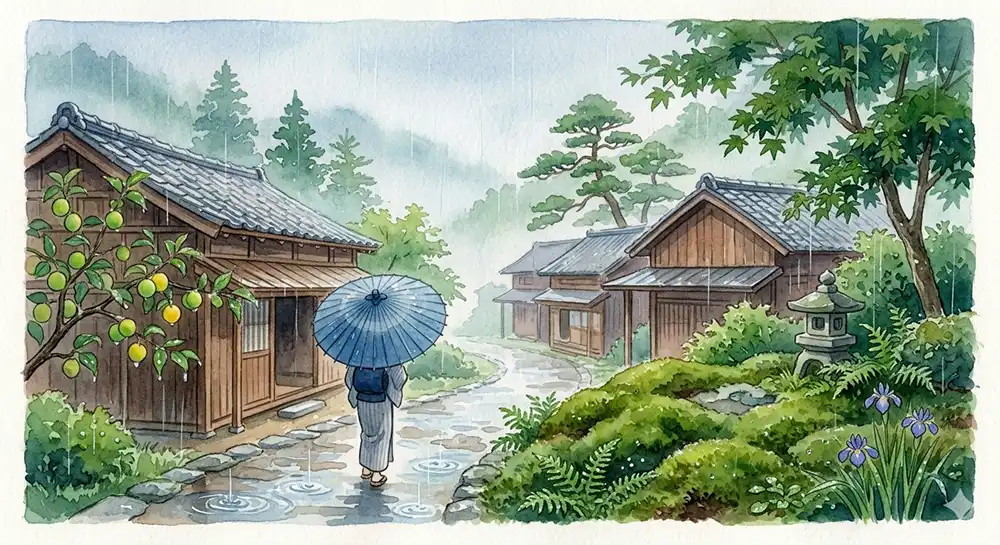
In June, the Japanese archipelago enters the "tsuyu" season, starting from the south.
The rainy season is Japan's rainy season that lasts about 40 days from early June to mid-July. Day after day of rain and high humidity continue, and the temperature gradually rises. At this time of year, Japan is enveloped in a humid atmosphere. "Jimejime" is a Japanese word that refers to humid and unpleasant conditions, and it best describes the atmosphere in Japan in June.
☔ Reason for writing “rainy season”
The kanji for ``rainy season'' is written as ``rainy season.'' The name is said to come from the rain that falls during the time when plum trees ripen. In June, plum fruits all over Japan turn yellow, marking the time of harvest. The very name of the rainy season incorporates the idea of fruit production.
Every year, the Japan Meteorological Agency announces the beginning of the rainy season and the end of the rainy season for each region. It is a rare system in the world for a national organization to officially declare the start and end of the rainy season. When the rainy season is announced on the news, Japanese people start preparing umbrellas and dehumidifiers.
During the rainy season, the average humidity in Japan reaches 70-80%. The rainy season is an annual problem for Japanese people: laundry doesn't dry, mold grows easily, and hair doesn't stay tame. On the other hand, rain is essential for rice cultivation, as it coincides with the rice planting season, when rice fields are filled with water.
Key points to understand
Here are some points to keep in mind when visiting Japan during the rainy season.
- Regional differences:The timing of the rainy season varies depending on the region. Normal weather is around mid-May in Okinawa, early June in Kyushu and Shikoku, and mid-June in Kanto. Hokkaido does not have a clear rainy season, only a short rainy season called the Ezo rainy season. Rain conditions vary greatly depending on your destination.
- Transparent vinyl umbrella:You can buy transparent vinyl umbrellas at convenience stores in Japan for around 500 to 700 yen. The convenience of being able to get an umbrella in case of sudden rain is an aspect of Japanese convenience store culture. During the rainy season, a large number of transparent vinyl umbrellas are lined up in umbrella stands at stations.
- How to spend time indoors:During the rainy season, where there are many rainy days, places where you can enjoy indoor activities such as art museums, museums, department stores, and hot springs tend to become crowded. On the other hand, outdoor tourist spots are often less crowded than usual, and rainy Kyoto and Kamakura are less crowded, making for a quiet stroll.
- Rainy season and food:The rainy season is also the season when food poisoning cases increase. Japanese restaurants and households take special care in handling perishables during this time of year. On the other hand, the humidity during the rainy season is suitable for brewing sake and fermenting miso and soy sauce, and Japan's fermented food culture is inseparably linked to the hot and humid climate.
🌧️ Enjoy rainy Japan
It's highly likely that you won't be able to avoid rain when traveling to Japan in June, but there are some scenery that can only be seen in the rain. Hydrangeas become more vivid in color when they get wet in the rain, and moss gardens become greener with the rain. The gardens of Kyoto's Moss Temple (Saihoji) and Tofukuji are said to be more beautiful on rainy days than on sunny days.
The rainy season is a unique seasonal classification in Japan, and visiting Japan during this time is a seasonal experience in itself. If you have a folding umbrella and a towel in your bag, you'll be ready to walk through rainy Japan.