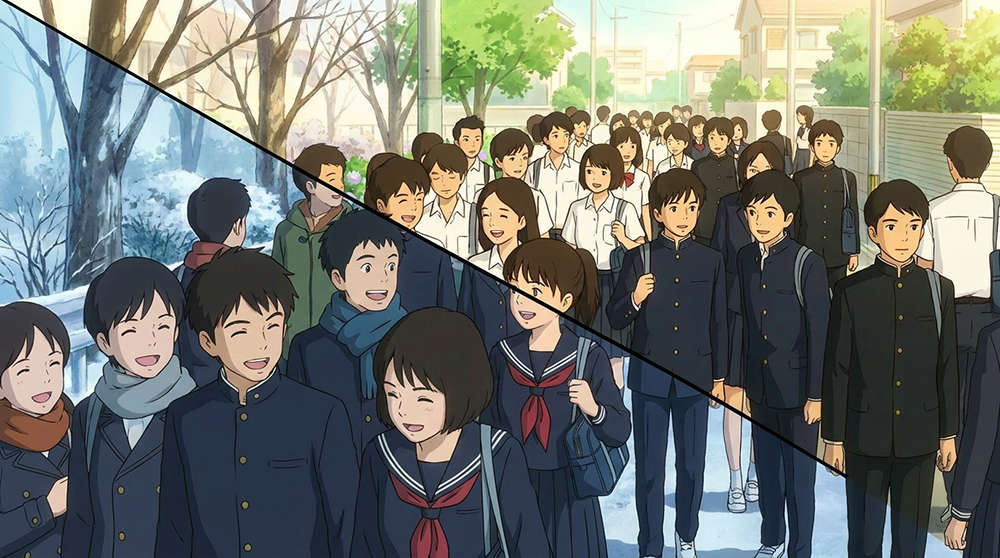
On June 1st, all students at schools across Japan will switch from winter uniforms to summer uniforms.
"Koromogae" is a Japanese custom of changing clothes according to the season. Not only schools, but many companies and government offices also switch to summer clothing from June 1st, and the attire of people walking around town changes in one day.
👔 Customs that have continued since imperial court events during the Heian period
The origin of changing clothes lies in the Heian period imperial court event called ``Koi.'' At that time, it was the imperial court's rule that nobles change from winter clothing to summer clothing on April 1st of the lunar calendar, and from summer clothing to winter clothing on October 1st. The material, color, and layering of costumes were determined in detail for each season, and expressing the seasons through clothing was part of court culture.
In the Meiji period, when the government adopted Western clothing, it designated June 1st and October 1st of the new calendar as days for changing clothes. This system, which started with uniforms for soldiers and government officials, eventually spread to school uniforms and continues to this day. Although it is not required by law, most schools designate June 1st as Clothing Change Day.
Key points to understand
This is a key point to understand Japanese kimono.
- Uniform culture and changing clothes:Most junior high and high schools in Japan use uniforms. Winter clothes change to navy blue or black blazers and stuffed collars (school uniforms), and summer clothes change to white shirts or polo shirts. On the morning of June 1st, the sight of students walking to school all at once changing color from dark to white is one of the early summer scenes in Japan.
- Existence of “transition period”:In recent years, an increasing number of schools have established a "transition period" from late May to early June, allowing students to wear either winter or summer clothes. This is a method that each person decides based on the temperature. However, most schools officially mark June 1st as the official changeover date, and winter clothing almost disappears after this date.
- Change of clothes at home:In addition to uniforms, Japanese families also have a custom of changing out the contents of their closets around June. This involves washing and cleaning winter coats and sweaters, storing them, and taking out summer clothes. ``Shimaarai,'' which involves putting insect repellent in clothes and putting it away in a costume case, is a seasonal event in Japanese households.
- Change of clothes for winter on October 1st:The change from summer to winter is October 1st. Japanese people are conscious of the change of seasons by changing their clothes twice a year, in June and October. Even in companies, the start and end of "Cool Biz" (lightly dressed work from May to September) is linked to changing clothes, and the days when people take off their neckties and put them back on are gradually aligned throughout society.
👘 A culture that expresses the seasons through clothing
In Japan, there is a sense of placing importance on ``dressing according to the season.'' In the world of kimono, June is the month when unlined ``Hitoe'' clothing is worn, and July and August are the months when people wear ``Usumono'' made from transparent materials. Even in today's clothing-centric world, there are many people who feel uncomfortable about still wearing winter clothes in June.
If you visit Japan in early June, you may come across students who had been wearing black or navy uniforms the day before, now wearing white shirts. The color of the city changes depending on the date on the calendar. Changing clothes is the day when you can most clearly see how Japanese people divide seasons by clothing.