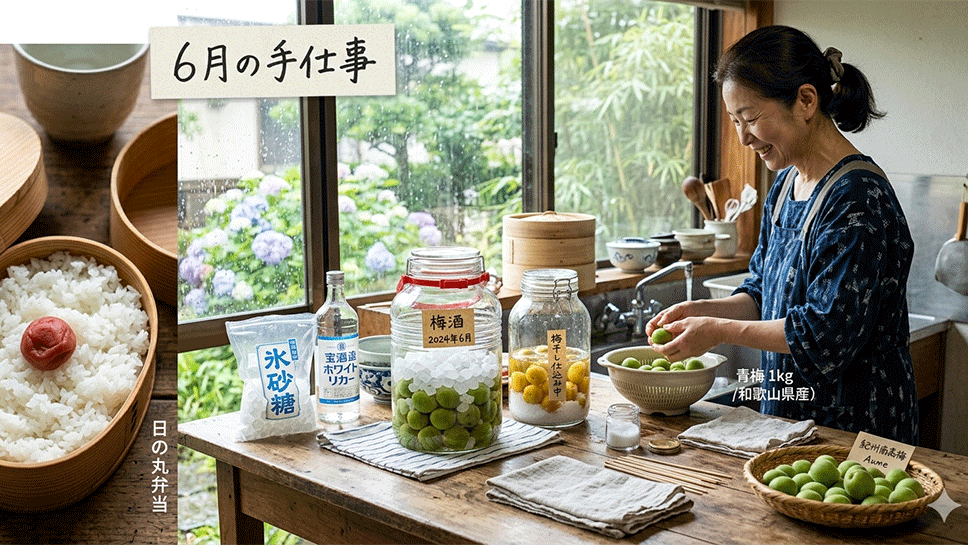
In June, green plums begin to appear in gardens and supermarkets all over Japan. The name of the rainy season, written in Japanese as "Tsuyu", is said to come from the fact that it coincides with the time when the plum trees ripen. Plum fruit has a long history as an edible food, and China, Korea, and Japan have shared a culture of processing and eating plums since ancient times. In Japan, the process of preparing preserved foods and drinks using plum fruits during this period is called ``umeshigoto'' (umeshigoto), and many families do this as an annual custom.
🫙 Plum work - Kitchen work in June
The representative product of plum work is ``Umeboshi''. It is a preserved food made by drying salted plum fruits in the sun, and is characterized by its strong sour and salty taste. It is also a symbol of Japanese bento culture, and a bento with a red pickled plum in the center of white rice is called a ``Hinomaru bento.''
Another standard is ``Umeshu''. Green plums, rock sugar, and shochu are placed in a wide-mouthed bottle and soaked for over 3 months. The amount of sugar and pickling period vary from household to household, and ``Uchi no Umeshu'' is one of the flavors of Japanese homes.
In addition, plum syrup (for children and non-drinkers), plum jam, and plum miso are also made.
Umeboshi originated in China and is said to have been introduced to Japan in the Nara period (8th century). Initially, it was used as a medicine, and during the Sengoku period (16th century), it was valued as military food. Even now, there is a widespread belief in Japan that umeboshi are good for the body.
Points of plum work
- season:Green plums are available from early to mid-June, and ripe yellow plums (ripe plums) are available in stores in late June. Green plums are suitable for making plum wine and syrup, and ripe plums are suitable for making pickled plums.
- Experience:You can experience picking plums at tourist farms in Wakayama Prefecture (Japan's largest plum producing region) and Gunma Prefecture. You can take home the harvested plums on the spot and process them into your own plum wine or pickled plums.
- purchase:Plum fruits are sold in 1kg units at the produce section of supermarkets and department stores. Glass bottles and rock sugar for plum wine will also be available at a special corner at the same time, so you can stock up on all the ingredients at once.
- Hinomaru bento:A bento box with a red pickled plum placed in the center of white rice is called a Hinomaru Bento (Hinomaru Bento) because its appearance resembles the Japanese flag. It often appears in Showa literature and movies as a symbol of frugal meals.
🐟 Sardines in the plum season - the fish that is most fatty during the rainy season
Ma-iwashi, caught during the rainy season, is called "Nyuubai Iwashi" and has the highest fat content of the year. This is because the rainy season coincides with the time when they accumulate nutrients before spawning.
In particular, Choshi City in Chiba Prefecture is one of Japan's leading sardine landing ports. From June to July, restaurants in Choshi offer special menus such as sardine sashimi, namerou, fishball soup, and kabayaki.
Sardines are one of the most familiar fish on the Japanese diet, but because they tend to lose their freshness, the taste of sardine eaten in the area where it is produced is distinctly different from that in urban areas.
The plums ripen and the sardines grow fat. It rains a lot in Japan in June, making it a less-than-comfortable season for travelers. However, in this humid atmosphere, Japan's food culture is the most active of the year. You can get a sense of Japan's seasonal spirit just by looking at the special corner of a supermarket lined with tools for plum work. If you are able to take a day trip to Choshi or Wakayama, you can also experience Nyuume sardine sashimi and plum production areas on the same itinerary.