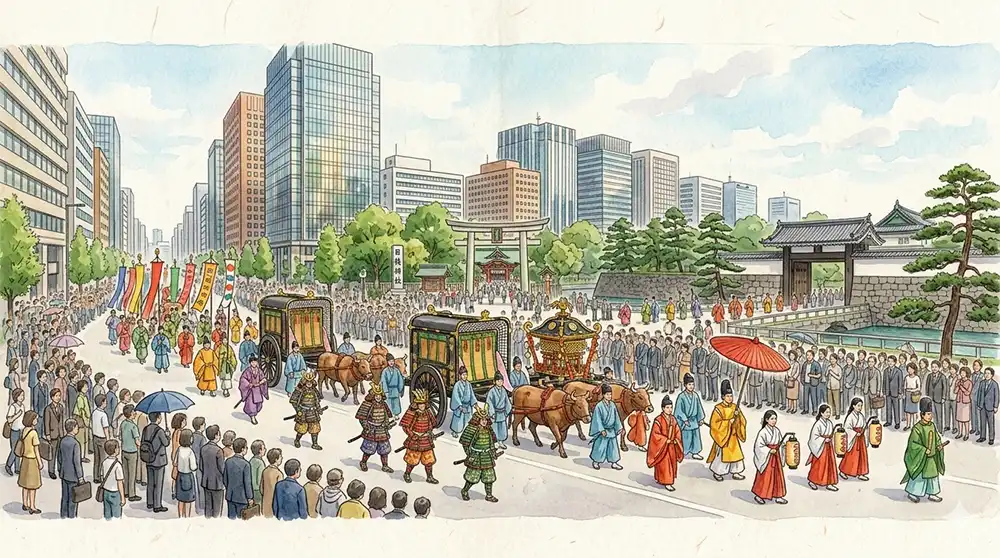
Once every two years, there is a day when the center of Tokyo is filled with festival processions from the Edo period. This is Sannou Matsuri at Hie Shrine. In 2026, it will be held for 11 days from June 7th to 17th, and since this year is the year of the ``Hon Matsuri'', the biggest highlight will be the ``Jinko-sai''.
👘 Jinko-sai - Edo's Tenka Festival travels through Tokyo
The Jinko Festival will be held on Friday, June 12, 2026. A procession of about 500 people wearing dynasty costumes parades through central Tokyo, centering around two Gohoren (Phoenix), one Mikoshi (portable shrine), and a float.
The procession leaves Hie Shrine (Akasaka) in the morning and heads from Nagatacho to Hanzomon via Kojimachi Odori. Around noon, the train will pass from the area around the Imperial Palace to Tokyo Station and Nihonbashi. In the afternoon, proceed to Kasumigaseki via Ginza and return to Hie Shrine.
This festival was called ``Tenka Matsuri'' during the Edo period, and was one of the few festivals for which the procession was allowed to enter Edo Castle. There is a record that the shogun directly visited the castle from inside the castle. It is counted as one of the two major festivals of Edo, along with the Kanda Festival, and the system of holding the main festival alternately every other year continues to this day.
Viewing points for the Jinko Festival
- schedule:Friday, June 12, 2026. The procession leaves Akasaka in the morning and returns to Hie Shrine in the evening. Roadside viewing is free.
- Recommended viewing places:The streets of Nihonbashi and Ginza are wide, making it easy to photograph the procession from the front. Near Hanzomon, you can take photos with the moat of the Imperial Palace in the background.
- Clothes and attire:Participants in the procession wear costumes from the Heian to Edo periods. The procession is a mix of costumes from different eras, including armored warriors, children, shrine maidens, and Shinto priests, creating a unique scenery that contrasts with Tokyo's skyscraper district.
- “Main Festival” and “Shadow Festival”:The main festival of the Sanno Festival is held in even-numbered years, and the Kage Festival is held in odd-numbered years. In the year of the Yin Matsuri, the Jinko Festival is not held, and only rituals are held inside the shrine. 2026 is the main festival since it is an even year.
⛩️ Hie Shrine and Sanno Faith
Hie Shrine is located in Nagatacho, Chiyoda Ward, Tokyo, near the National Diet Building. It was revered by Tokugawa Ieyasu as the guardian deity of Edo Castle, and the subsequent Shogun families protected the festival from generation to generation. The enshrined deity is Ooyamakui no Kami, who is considered the god of the mountains and protector of agriculture and industry.
The current Hie Shrine is located in a corner of Akasaka's business district, and its distinctive approach is an escalator that faces Sotobori Street. The area is surrounded by the National Diet Building, the Prime Minister's Official Residence, and downtown Akasaka, and the sight of a procession of Heian costumed people walking through modern-day Tokyo during the Shinko Festival is something you won't see in any other city.
The Jinko Festival is held on weekdays (Fridays). In Nihonbashi and Ginza, many office workers go out on the streets during lunch, creating a scene unique to Tokyo, where a picture scroll of the dynasty moves forward as you pass office workers. Roadside viewing is free and no special reservations are required. Access: Tokyo Metro Tameike-Sanno Station (nearest Hie Shrine), Ginza Station, and Nihonbashi Station are all along the procession route.