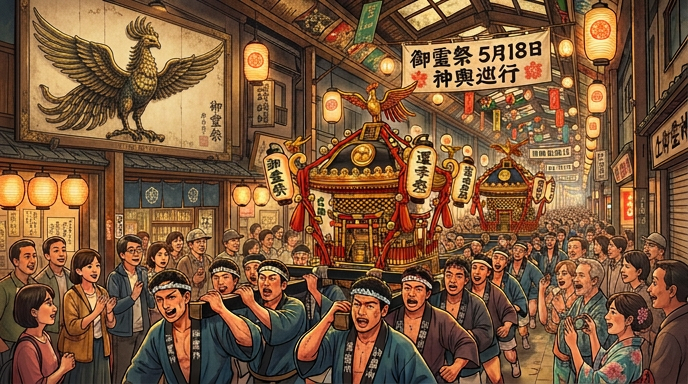
On May 18th, three portable shrines will be carried out from Kamigoryou Shrine in Kamigyo Ward, Kyoto City to the shrine parishioners town.
This is the return festival for the Goryo Matsuri. This festival, which began to appease vengeful spirits, is a Kyoto festival that has a history of more than a thousand years, and may be even older than the origins of the Gion Festival.
👻 The beginning of vengeful spirit belief and spiritual gatherings
Kamigoryo Shrine dates back to 794, when Emperor Sudo was enshrined during the transfer of the capital to Heiankyo. Emperor Sudo was Emperor Kanmu's younger brother, Imperial Prince Sawara, who was imprisoned for a crime he did not commit and died after starving. After that, as epidemics and natural disasters continued, it was feared that it was the work of the vengeful spirit of Imperial Prince Sawara, and the shrine was pacified by giving Emperor Sudo a posthumous title.
After that, the spirits of noble people who died tragic deaths were enshrined together, and now eight deities are enshrined here. In 863 (the 5th year of the Jokan era), a ``goryoe'' was held at Shinsen-en Garden to appease the spirits of the dead, by order of Emperor Seiwa. This is said to be the origin of the spirit festival.
Kamigoryo Shrine is also the place where the Onin War broke out. In 1467, an armed conflict between Masanaga Hatakeyama and Yoshinari Hatakeyama of the Muromachi Shogunate occurred in Goryo no Mori, and this developed into the Onin War, a war that spread across the country for more than 10 years. There is a stone monument in the precincts that says ``The place where the Onin War broke out.''
Points of appreciation
This is the point to see the Goryo Festival.
- Kankosai procession:At the Kanko Festival on May 18th, three mikoshi from Oyamago, Imade Kawaguchi, and Suehiro will be paraded through the parishioners town along with goryo drums, sword hoko, saotome, chigo, young samurai, oxcarts, and lion dancers. The togo ceremony is held in the morning, and the procession departs around 1 p.m. Pass through the arcade of Demachi Masugata Shopping Street, tour Kyoto Gyoen National Garden, and return to the shrine near dusk.
- Walking through the shopping arcade:One of the highlights of Kankosai is the sight of a mikoshi passing through the narrow arcade of Demachi Masugata Shopping Street. The sound of the ringing bell and the shouts of the bearers reverberate through the arcade, giving it a uniquely powerful feel.
- Yoimiya (May 17th):On the 17th, the day before Kankosai, there is Yoimiya, where stalls are lined up in and around the shrine grounds. Goryo Taiko performances are also held, and the festival is crowded with locals. Three mikoshi and two children's mikoshi are enshrined in the worship hall, waiting to be paraded the next day, and you can see them up close.
- access:Kamigoryo Shrine is about a 3-minute walk from Kuramaguchi Station on the Karasuma Subway Line. It is also within walking distance from the Kyoto Imperial Palace, so you can visit it in conjunction with a stroll around the Imperial Palace. The Kankosai procession route stretches throughout Kamigyo Ward, so you can view it from various locations along the route.
⚔️ Standing in the land of vengeful spirits
The grounds of Kamigoryo Shrine are located in a residential area away from the downtown area, so there are not many tourists. Although it is the place where the Onin War broke out and the place where the spiritual gatherings, which are said to be the origin of Japan's belief in vengeful spirits, were held, the temple grounds are usually quiet.
Kankosai, the Goryo Festival, is the busiest day of the year in the quiet precincts. The location is a 3-minute walk from Kuramaguchi Subway Station and on the north side of the Kyoto Imperial Palace, making it an area with easy access to Kinkaku-ji Temple and Shimogamo Shrine. Enjoy the food stalls and Goryo Taiko drums at Yoimiya on May 17th, and follow the Kanko Festival procession the following day on the 18th. Just by going a little off the tourist route in Kyoto, you can witness a festival to appease vengeful spirits that has been going on for over a thousand years.