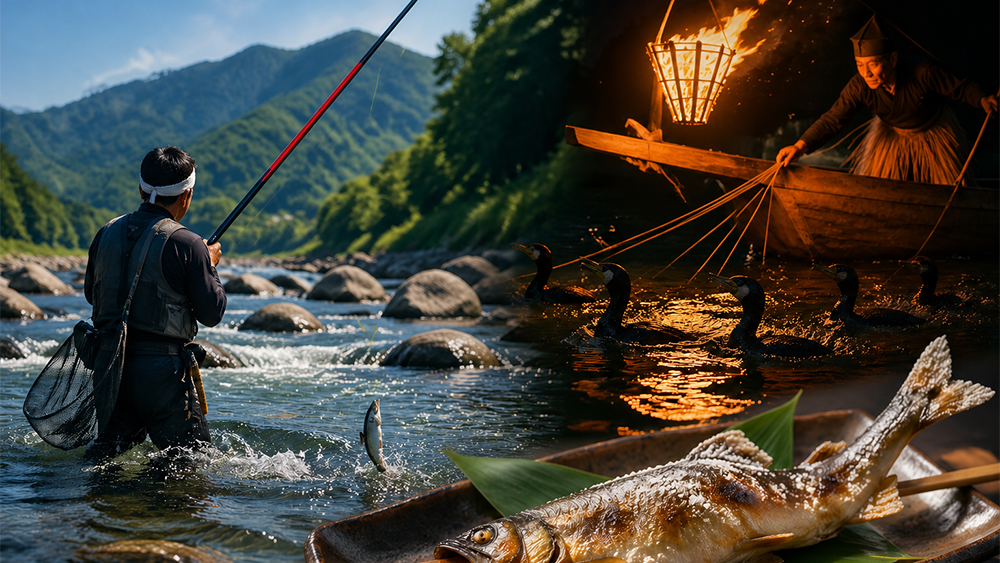
Around June 1st, the ban on sweetfish fishing will be lifted in rivers across Japan.
Ayu is a freshwater fish that the Japanese call the "queen of river fish." The body length is approximately 20-30cm. They live only in clear streams and grow by feeding on moss attached to rocks at the bottom of rivers, giving their flesh a unique scent similar to watermelon or cucumber. Because of this scent, it has another name, ``kougyo.''
🎣 Japan's unique fishing method "Friend fishing"
Tomozuri is the most widely practiced method of fishing for sweetfish in Japan. This fishing method is said to be rare worldwide.
Ayu is a fish with a strong sense of territory. If other ayu enter their feeding area, they will try to chase them away by ramming them. Friendship fishing is a fishing method that takes advantage of this habit. A live sweetfish is released into the river as a "decoy" with a hook attached to it, and when a territorial wild sweetfish approaches it, the bait is hooked onto the bait and fished out.
The rods used for tomo fishing are extremely long, measuring 8 to 10 meters, and anglers stand waist-deep in the river to manipulate the rods. When the fishing season opens in June, anglers can be seen lining up from early morning on popular rivers all over the country.
Points of experience
Here are some points about sweetfish fishing and cormorant fishing.
- Cormorant fishing on the Nagara River (Gifu Prefecture):Ukai is a traditional fishing method that uses trained cormorants to catch sweetfish. Cormorant fishing on the Nagara River in Gifu City, Gifu Prefecture, has a history of more than 1,300 years, and it also plays the role of presenting sweetfish to the imperial family as the Imperial Household Agency's ``goryo ukai.'' A fisherman called a usho controls 10 to 12 cormorants from a boat with a lit bonfire, and the cormorants dive into the river and swallow the ayu whole before returning to the boat. A string is tied around the cormorant's throat, which prevents it from swallowing ayu larger than a certain size, so the cormorant fisher collects it by spitting it out of its mouth. You can see it from the river on a viewing boat, and the season is from May 11th to October 15th.
- How to eat sweetfish:The typical way to eat ayu is grilled with salt. Sprinkle salt on the skewered sweetfish and slowly grill over charcoal. The connoisseur's way of eating it is to eat the whole innards, and the unique bitterness goes well with the aroma of ayu. You can eat freshly grilled sweetfish over charcoal at restaurants and sightseeing spots along the river.
- Experience at “Yana”:``Yana'' is a traditional fishing method in which a bait made of bamboo or wood is set up in the river to catch ayu that floats by. At ``Yanaba'', which has been set up for sightseeing, you can eat the sweetfish you catch on the spot as salt-grilled or sashimi. There are famous yanaba in Gujo Hachiman in Gifu Prefecture and along the Nakagawa River in Tochigi Prefecture.
- Access for viewing cormorant fishing:The boarding point for cormorant fishing on the Nagara River is approximately 15 minutes by bus from JR Gifu Station. Advance reservations are required for the observation boat, and early reservations are required during the season. The boarding fee is around 3,500 yen for adults. It is common to watch cormorant fishing while eating a boxed lunch on the boat.
🐟 Land of river fish
Japan, an island nation, has a strong image of sea fish, but the country's land of mountains and rivers also has a rich river fish culture. In addition to ayu, there are cultures around the world that eat fish that grow in clear streams, such as rockfish, yamame, and rainbow trout.
If you travel to rural areas of Japan in June, you are likely to see signs for ``Salt-grilled Ayu'' at roadside stations and restaurants along rivers. Cormorant fishing on the Nagara River is held in the center of Gifu City, and is easily accessible from Nagoya, about 20 minutes by JR train. The sight of cormorants catching ayu on the river illuminated by bonfires makes you realize that the same fishing methods used 1,300 years ago continue in modern Japan.